Written By Divya
Edited By: Divya | Published By: Divya | Published: Jun 08, 2026, 01:58 PM (IST)

 Earth braces for solar storm as NOAA issues G3 alert (Image: AI Generated)


Written By Divya
Solar Flare: A powerful solar eruption is heading towards Earth, and space weather agencies are keeping a close watch on it. The US National Oceanic and Atmospheric Administration (NOAA) has issued a G3 geomagnetic storm watch for June 8 and a G2 watch for June 9 following a coronal mass ejection (CME) that erupted from the Sun on June 6.  Also Read: India’s Mission Drishti loses contact after solar storm, recovery chances low
But the big question for many skywatchers is — how will this solar event impact you, and will India see any impact? Know all the details. Also Read: Meet NASA's Artemis III crew: The astronauts preparing for the next Moon mission
The activity began when an active region on the Sun released an M-class solar flare along with a fast-moving cloud of magnetised solar material, known as a coronal mass ejection (CME). A CME is a massive burst of charged particles and magnetic fields that gets thrown into space. When one is directed towards Earth, it can interact with our planet’s magnetic field and trigger a geomagnetic storm. Also Read: NASA astronauts may soon wear Prada on Moon missions
According to NOAA, the incoming CME could generate strong geomagnetic activity as it reaches Earth.
NOAA’s forecast models and space experts suggest the solar cloud could begin interacting with Earth’s magnetic field on June 8, that is today. However, there is still some uncertainty about the exact timing and strength of the impact.
“The NASA and NOAA model prediction runs show two possibilities: a fast, near direct hit (early June 8) and a slower, near flanking blow (mid-day June 8),” Space weather expert Dr Tamitha Skov explained. According to Skov, the final outcome will depend on how the solar storm interacts with the solar wind during its journey towards Earth.
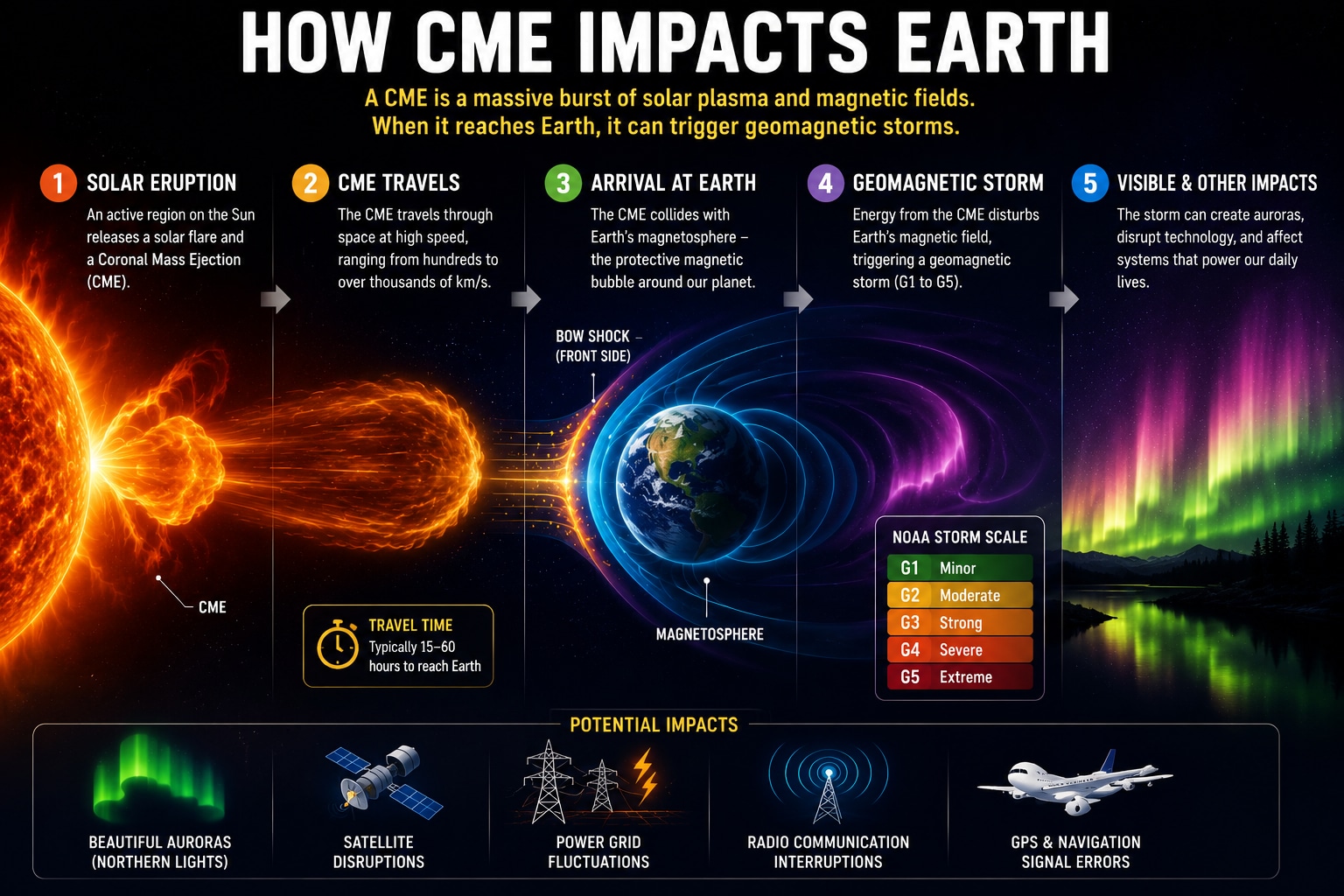
Image Credits: AI
The question many people have is whether this solar storm could make auroras visible in India.
Last year, during the powerful geomagnetic storm of May 2024, auroras were spotted from several unusual locations around the world, including parts of India. But this time, experts aren’t making any such predictions yet.
The current forecast points to a G3 geomagnetic storm, which is strong enough to push auroras farther south than usual. Whether that happens, however, will depend on how the incoming solar cloud behaves when it reaches Earth.
The answer will only become clear when the CME gets closer to Earth. One key factor is the magnetic field carried by the solar cloud. If it aligns in a certain way with Earth’s magnetic field, the storm could become stronger than expected. If not, the impact could remain relatively limited.

For now, scientists are tracking the CME as it travels through space. A clearer picture is expected only a few hours before arrival, when monitoring satellites get a chance to analyse the incoming solar material in greater detail.

Don't Miss Out the Latest Updates. Subscribe to Our Newsletter Today!