
Written By Shubham Arora
Edited By: Shubham Arora | Published By: Shubham Arora | Published: Jul 18, 2026, 09:58 AM (IST)
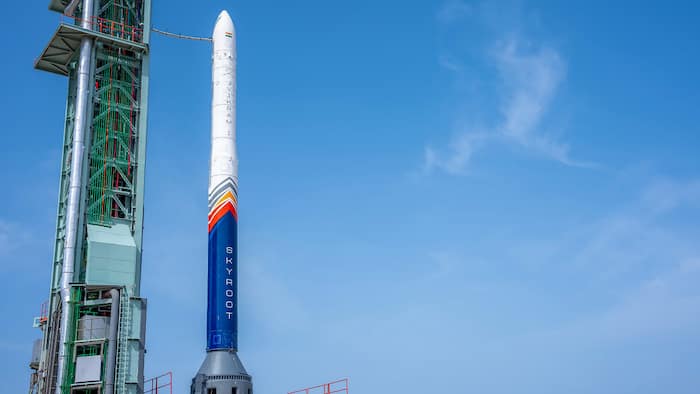
 Skyroot Aerospace's Vikram-1 rocket ahead of its first orbital launch under Mission Aagaman.


Written By Shubham Arora
India’s private space sector is about to cross an important milestone as Hyderabad-based Skyroot Aerospace prepares to launch its first orbital rocket, Vikram-1. The mission, named Mission Aagaman, is scheduled to lift off from the Satish Dhawan Space Centre (SDSC-SHAR) in Sriharikota at 11:30 AM today.  Also Read: ISRO changes resignation policy as more than 100 scientists reportedly exit
This is the first time an Indian private company will attempt to place a rocket into orbit from Indian soil. Until now, orbital launches have largely been led by ISRO. If Vikram-1 performs as expected, it could become a major step forward for India’s commercial space industry and strengthen the role of private companies in future launch missions. Also Read: India’s Mission Drishti loses contact after solar storm, recovery chances low
Skyroot says the vehicle has completed all major pre-launch checks, including integrated vehicle testing, telemetry interface verification and radar tracking validation. Speaking ahead of the launch, Skyroot Co-founder and CEO Pawan Kumar Chandana said the team has carried out extensive ground testing and is now looking forward to seeing how the rocket performs during its first flight. Also Read: India's FIRST private orbital rocket set to launch this month: All about Vikram-1
A historic new frontier for India’s space journey!
At 11:30 AM today, Skyroot Aerospace will undertake the maiden orbital launch of Vikram-1, India’s first privately developed launch vehicle.
This four-stage rocket is designed to provide rapid and on-demand launch services.… pic.twitter.com/1qFVTwNOuZ
— Narendra Modi (@narendramodi) July 18, 2026
Unlike a simple demonstration flight, Mission Aagaman has several objectives. Vikram-1 will attempt to deploy multiple technology payloads into a 450-kilometre Low Earth Orbit at an inclination of 60 degrees. The launch vehicle has a payload capacity of up to 350 kilograms.
Among the payloads are technology demonstrations from Grahaa Space, Cosmoserve, DCubed, and Skyroot’s own SCOPE experiment. The mission will also carry symbolic items, including Prime Minister Narendra Modi’s handwritten postcard carrying the message “Vande Mataram”, along with messages from current and former ISRO chairpersons, Indian astronauts, Skyroot engineers, and supporters.
One of the technology demonstrations on board is aimed at testing robotic arm technology that could eventually be used for removing space debris. The mission will also carry a miniature gold rocket containing micro sculptures of Dr Vikram Sarabhai, Dr APJ Abdul Kalam, and Sir C.V. Raman, along with a lab-grown diamond called Cosmic Bloom, making it one of the more unusual payloads flying on an Indian launch vehicle.
Vikram-1 is also significant because of the technologies Skyroot has built into the rocket. According to the company, it is India’s first orbital launch vehicle built using an all-carbon composite structure, helping reduce overall weight while improving strength.
The rocket also uses in-house developed propulsion systems, including solid rocket motors and a fully 3D-printed liquid engine that powers its Orbital Adjustment Module. Skyroot says this is the first time a 100% 3D-printed engine is being used on an Indian orbital launch vehicle.
The company has also developed India’s longest monolithic carbon composite rocket stage and introduced an ultra-low-shock pneumatic separation system for stage and payload separation. These technologies are expected to play an important role in future commercial launch missions.
Mission Aagaman comes nearly four years after Skyroot successfully launched Vikram-S, India’s first privately built suborbital rocket. This time, the challenge is much bigger as the company attempts to reach orbit for the first time.

For Skyroot, the mission is also about collecting flight data that can be used to improve future launches. The founders have previously said that even a successful liftoff and gathering real flight data would be a valuable outcome for the company.

Don't Miss Out the Latest Updates. Subscribe to Our Newsletter Today!