



Written By Shubham Arora
Written By Shubham Arora
Edited by Shubham Arora |Published: Jul 23, 2026, 06:17 PM (IST)
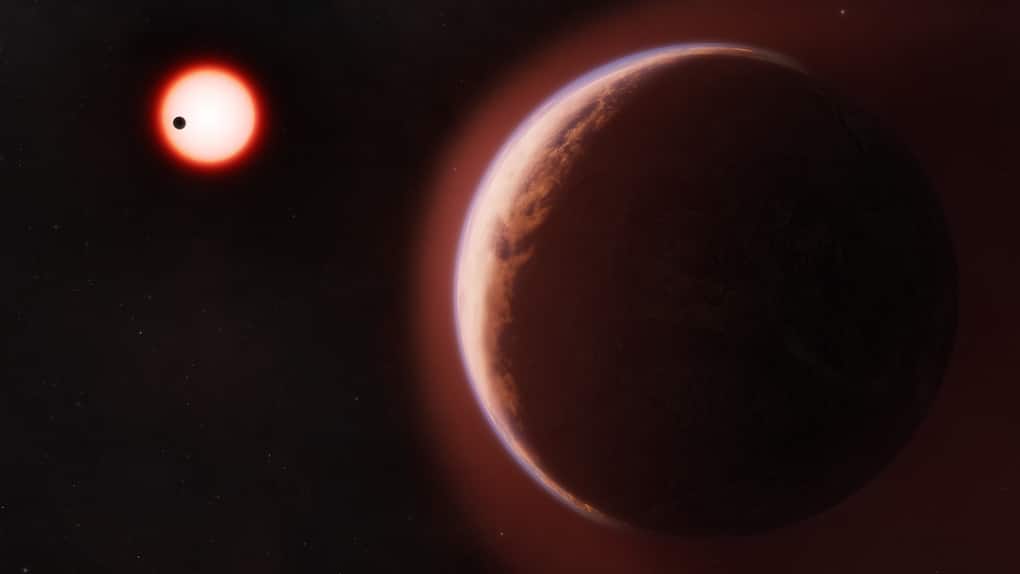
 Artist's impression of the Earth-like exoplanet LHS 1140 b orbiting its red dwarf star with an atmosphere detected by astronomers. (Image credits: Melissa Weiss/Center for Astrophysics | Harvard University)
Astronomers say they have found the strongest evidence yet that a rocky, Earth-like planet outside our solar system has an atmosphere. The finding is being seen as a major step in the search for planets that could support life beyond Earth. The planet, called LHS 1140 b, is about 49 light-years away and orbits its star at a distance where conditions may allow liquid water to exist. Scientists have discovered thousands of exoplanets over the years, but proving that any of them still have an atmosphere has remained a difficult task. According to the study, published in the journal Science, this is the first time researchers have found clear evidence of an atmosphere on a rocky planet located in another star’s habitable zone.  Also Read: Vikram-1 mission: India's first private orbital rocket to launch on July 18
LHS 1140 b circles a cool red dwarf star and lies in what’s known as the habitable zone, or the “Goldilocks zone.” This is the region around a star where temperatures are considered just right for liquid water to remain on a planet’s surface. But being in the habitable zone isn’t enough on its own. A planet also needs an atmosphere to help maintain stable temperatures and shield the surface from harmful radiation. Also Read: ISRO changes resignation policy as more than 100 scientists reportedly exit
According to the researchers, LHS 1140 b is the first rocky planet in a habitable zone where scientists have been able to detect evidence of an atmosphere. “An atmosphere is essential for a planet to support life as we know it,” lead author Collin Cherubim, who recently completed his PhD in Earth and Planetary Sciences at Harvard University, said in a statement. Also Read: Japan takes on Elon Musk's SpaceX with successful reusable rocket test
The discovery was made by observing helium escaping from the planet’s upper atmosphere. Before making the observations, Cherubim and his team had developed a theoretical model predicting that LHS 1140 b should contain a helium-rich upper atmosphere slowly leaking into space.
The team tested that prediction using the Warm Infrared Echelle (WINERED) Spectrograph at the Magellan Observatory in Chile. During a rare alignment, LHS 1140 b and another nearby planet passed in front of their star on the same night, giving astronomers a chance to compare both worlds under nearly identical conditions. While the second planet showed no signs of an atmosphere, LHS 1140 b produced a clear helium signal, confirming that it still retains one.
David Charbonneau, head of Harvard’s Department of Astronomy, said he initially doubted whether the observation would work because the prediction came from a mathematical model and such a signal had never been detected from a rocky planet before. After analysing the telescope data, however, the team described the detection as statistically strong.
Scientists have confirmed more than 6,300 exoplanets so far, according to NASA’s Exoplanet Science Institute, with thousands more candidates still awaiting confirmation. Many of these worlds are rocky planets, and some orbit within the habitable zones of their stars. However, proving that they still have atmospheres has been much more difficult.
Researchers estimate that LHS 1140 b may have kept its atmosphere for more than three billion years. That makes it an important target for future studies aimed at understanding its complete atmospheric composition and determining whether it may also have oceans or other surface features linked to habitability.

According to the researchers, the successful detection also shows that ground-based telescopes can be used to study the atmospheres of rocky exoplanets by looking for gases escaping into space. The team now plans to apply the same technique to search for other rocky worlds that may also have retained atmospheres, bringing scientists another step closer to identifying planets that resemble Earth.


