



Written By Shubham Arora
Written By Shubham Arora
Edited by Shubham Arora |Published: Jul 30, 2026, 12:54 PM (IST)
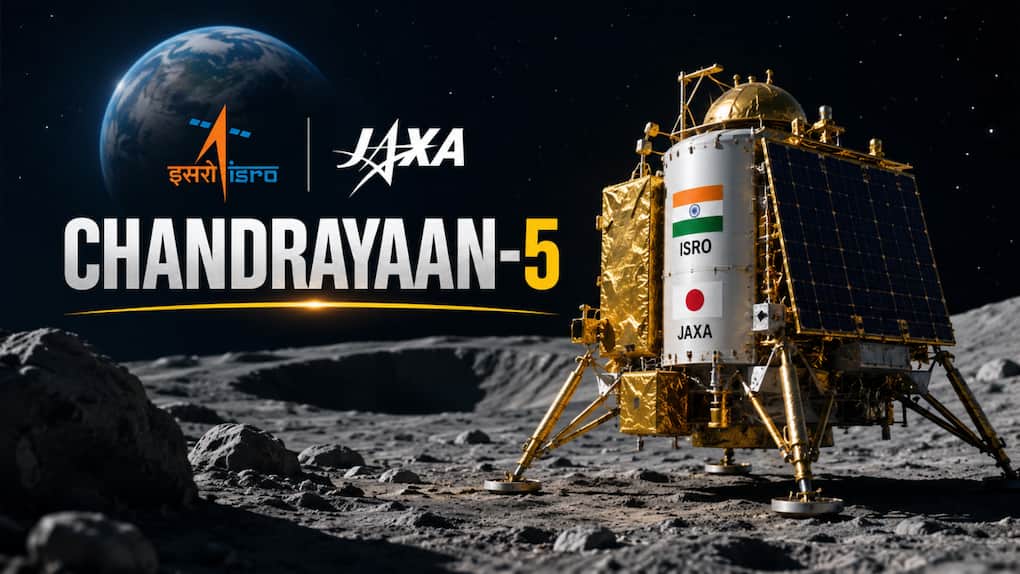
 ISRO and JAXA engineers review Chandrayaan-5 lander-rover systems during technical discussions in Bengaluru. (AI-generated image)
India’s next Moon mission has moved another step closer as scientists and engineers from the Indian Space Research Organisation (ISRO) and the Japan Aerospace Exploration Agency (JAXA) met in Bengaluru to continue work on Chandrayaan-5. Also known as the Lunar Polar Exploration (LUPEX) mission, Chandrayaan-5 will see the two space agencies work together to study the Moon’s south polar region, with a major focus on searching for water ice that could support future human missions.  Also Read: Vikram-1 successfully reaches orbit, marking a historic first for India’s private space sector
The technical discussions took place at ISRO’s U.R. Rao Satellite Centre (URSC), where teams from both countries reviewed key systems that will allow the Indian lander and Japanese rover to work together once they reach the lunar surface. The mission is currently targeted for launch around 2027-2028. Also Read: Skyroot Vikram-1 launch today: Everything you need to know about India’s first private orbital rocket
One of the biggest topics during the meeting was the Interface Control Specification (ICS), which defines how the Indian-built lander and the Japanese-developed rover will interact after landing on the Moon. Also Read: ISRO changes resignation policy as more than 100 scientists reportedly exit
Technical coordination is underway at ISRO's U R Rao Satellite Centre (URSC) in Bengaluru, India 🇮🇳. Discussions are focused on the ICS between the ISRO lander and the JAXA rover, as well as the rover's onboard science instruments. Strong collaboration between ISRO and JAXA teams… pic.twitter.com/dWBebmgkAJ
— Lunar Polar Exploration@JAXA(LUPEX) (@lupex_jaxa) July 29, 2026
The discussions focused on making sure both systems can exchange data, share power when required and communicate without issues during the mission. Since the rover will rely on the lander for several operations after touchdown, engineers from both space agencies are working to ensure that every interface between the two spacecraft functions as planned.
The meeting also included detailed reviews of the scientific instruments that will fly aboard the Japanese rover. These payloads are expected to study the lunar surface and collect data from the Moon’s south polar region, one of the least explored areas on the Moon.
A key objective of Chandrayaan-5 is to look for water ice hidden beneath the lunar surface, especially in permanently shadowed regions near the Moon’s south pole where sunlight never reaches.
Scientists believe these areas may contain frozen water that has remained trapped for billions of years. Finding out how much water exists, where it is located and how easily it can be accessed is considered important for future long-duration lunar missions.
Water found during the mission could prove useful in more ways than one. Apart from supporting future astronauts with drinking water, it could also be used to produce oxygen and even make rocket fuel. That is one of the reasons why scientists are keen to study the Moon’s south polar region in greater detail.
The mission is not limited to searching for water ice. Scientists also want to study the Moon’s south polar region in greater detail to understand how it formed and changed over billions of years.
Chandrayaan-5 will be very different from Chandrayaan-3. India’s previous lunar mission mainly focused at proving soft-landing technology and operating the Pragyan rover after landing near the Moon’s south pole in August 2023.

Chandrayaan-5 will carry a bigger rover being developed by the Japan Aerospace Exploration Agency (JAXA). Unlike Pragyan, this rover is expected to travel much farther and explore permanently shadowed regions near the Moon’s south pole, something Chandrayaan-3 was not designed to do.


