
Written By Shubham Arora
Edited By: Shubham Arora | Published By: Shubham Arora | Published: Jul 18, 2026, 02:29 PM (IST)
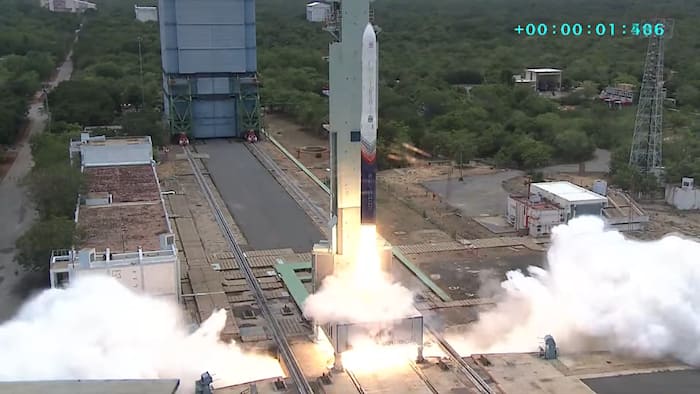
 Skyroot Aerospace's Vikram-1 lifts off from Sriharikota during Mission Aagaman, India's first private orbital rocket launch. (Image: Skyroot Aerospace/ X)


Written By Shubham Arora
India’s private space sector has crossed a major milestone. Skyroot Aerospace successfully placed its Vikram-1 rocket into orbit on Saturday (July 18), making India only the third country after the United States and China to achieve an orbital launch through a private company. The mission, named Aagaman, lifted off from the Satish Dhawan Space Centre in Sriharikota and completed all its planned objectives, marking a significant step for India’s commercial space industry.  Also Read: Skyroot Vikram-1 launch today: Everything you need to know about India’s first private orbital rocket
The Hyderabad-based startup had earlier made headlines in 2022 when its Vikram-S became the first privately built Indian rocket to reach space. Vikram-1 takes that journey a step further by becoming the country’s first privately developed orbital launch vehicle. Also Read: Google AI Mode introduces more connected apps: YouTube Music, Canva, and Instacart
Vikram-1 lifted off from the Satish Dhawan Space Centre at 12:05 pm IST and followed its planned flight path before deploying its payloads into a 450-kilometre low Earth orbit. Around 17 minutes after launch, mission control confirmed that the test flight had successfully completed all mission objectives. Also Read: ISRO changes resignation policy as more than 100 scientists reportedly exit
Hello space, we have arrived! Vikram-1's Test Flight-1 has completed it's mission.
The first ever Indian private sector launch has been successfully completed. #Vikram1 #MissionAagaman #OpeningSpaceForAll
— Skyroot Aerospace (@SkyrootA) July 18, 2026
The launch was primarily designed to evaluate the rocket’s performance and validate its onboard systems during an orbital mission. According to Skyroot Aerospace, the company’s SCOPE satellite was also onboard to collect flight data that will be used to analyse the rocket’s performance and support future missions.
The company confirmed that Vikram-1 successfully reached orbit, completing the first test flight of its orbital launch vehicle.
Apart from Skyroot’s own SCOPE satellite, Vikram-1 carried several customer payloads. These included a technology demonstration from German company DCUBED, the Solaras S3 nanosatellite pathfinder developed by Indian startup Grahaa Space, and Embrace, a robotic arm built by Cosmoserve Space that is designed to capture space debris.
The rocket also carried a few symbolic payloads. These included a miniature 18-karat gold rocket created by artist Ajay Kumar Mattewada and Cosmic Bloom, a jewellery piece developed by Cosmos Diamonds using lab-grown diamonds. According to some local reports, the mission also carried a commemorative postcard written by Prime Minister Narendra Modi along with other symbolic items.
Named after Indian space pioneer Dr Vikram Sarabhai, Vikram-1 is a four-stage launch vehicle standing about as tall as a seven-storey building and weighing around 40 tonnes. The rocket can carry up to 350 kilograms of payload to low Earth orbit and around 260 kilograms to a Sun-synchronous orbit. It uses a 3D-printed liquid engine in combination with solid propulsion stages and can reach speeds of nearly 8 kilometres per second during flight.
The company has already outlined its next vehicle, Vikram-2, which is expected to launch in 2027. According to Skyroot, the next-generation rocket will increase payload capacity to 900 kilograms for low Earth orbit and 600 kilograms for Sun-synchronous orbit, further expanding the company’s commercial launch capabilities.

Shortly after the mission, Indian Space Association Director General Lt Gen AK Bhatt (Retd.) described the successful launch as a defining milestone for India’s space program, saying it demonstrated that the country’s private industry is now capable of carrying out end-to-end orbital space missions.

Don't Miss Out the Latest Updates. Subscribe to Our Newsletter Today!