
Written By Shubham Arora
Published By: Shubham Arora | Published: Dec 16, 2025, 10:41 PM (IST)
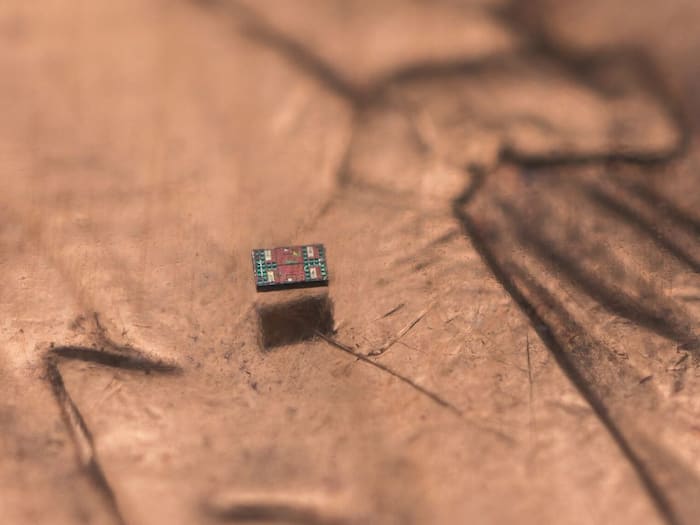
 Image credit: Michael Simari


Written By Shubham Arora
Scientists from the University of Pennsylvania, working with researchers at the University of Michigan, have unveiled what are being described as the world’s smallest fully programmable and autonomous robots. These microscopic robots – each roughly the size of common microorganisms (0.2 x 0.3 x 0.05 millimetres) – can move on their own, respond to environmental changes, and even sense temperature, all while costing just about a penny to produce.
The micro-swimmers are powered entirely by light and controlled through an ultra-compact onboard “brain” designed at the University of Michigan. The tiny computing system inside these robots helps them carry out simple tasks and change how they move depending on what’s happening around them. The project, backed by the National Science Foundation, could eventually prove useful in medical settings – for example, keeping track of cell-level changes or operating in places too small for traditional tools.
Marc Miskin, assistant professor at the University of Pennsylvania and senior author of the studies published in Science Robotics and PNAS, said the team has managed to shrink autonomous robots by an unprecedented scale. “We’ve made autonomous robots 10,000 times smaller,” Miskin noted, adding that the achievement opens the door to entirely new possibilities for programmable machines.
Even with their microscopic size, the robots can move in surprisingly complex ways. The robots can swim freely on their own or move together in coordinated groups, almost like a tiny school of fish. And because their propulsion system doesn’t use any moving parts, they’re surprisingly durable. Researchers say they can simply lift them with a micropipette and the robots will keep working for months.
Moving at such a small scale has always been one of the biggest hurdles in robotics, since microscopic devices face heavy drag when moving through liquid. The Penn Engineering team tackled this by flipping the problem around. Instead of trying to propel the robot itself, they make the robot push the water. It generates an electrical field that causes nearby ions to shift, and those ions then push the surrounding water molecules.

On the computing side, the Michigan team created a custom low-power system that runs on just 75 nanowatts, with most of the robot’s surface occupied by solar cells to harvest energy from light pulses. Each robot also carries a unique identifier, enabling researchers to program them individually for different tasks within the same group.

Don't Miss Out the Latest Updates. Subscribe to Our Newsletter Today!