
Written By Shubham Arora
Published By: Shubham Arora | Published: Jan 28, 2026, 03:31 PM (IST)
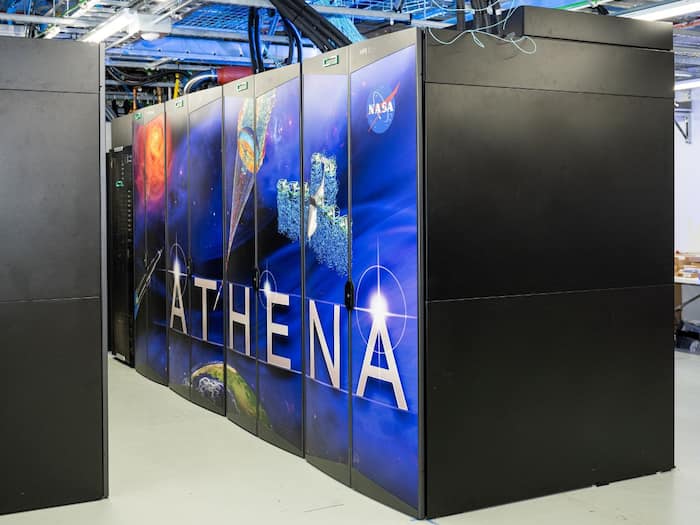
 Athena is NASA's most powerful and efficient supercomputer yet. (Image source: NASA)


Written By Shubham Arora
NASA has launched a new supercomputer – named Athena – that will help in its research and missions. Athena is now the space agency’s most powerful and energy-efficient system that it has used so far. The supercomputer is designed to handle large simulations, heavy data processing, and AI workloads that are increasingly part of space and aeronautics research.  Also Read: OpenAI may bring Sora AI video generator directly to ChatGPT
Athena is part of NASA’s High-End Computing Capability programme and is housed at the Modular Supercomputing Facility at NASA Ames Research Center in Silicon Valley. The system has been gradually rolled out to users since January, following a beta testing phase with researchers who were previously using older systems. Also Read: Adobe brings AI assistant to Photoshop and new Firefly editing tools
According to NASA, Athena now sits at the top of its computing stack, replacing earlier systems such as Aitken and Pleiades as the agency’s primary high-performance machine. Also Read: YouTube’s AI tool to detect deepfakes now available to journalists and government officials
NASA says Athena can deliver over 20 petaflops of peak performance, allowing it to carry out more than 20 quadrillion calculations every second. This makes it the fastest supercomputer currently in operation at the agency. NASA has also said the system is more efficient than earlier machines, helping lower computing and power costs.
NASA officials have said the goal was not just raw speed, but a system that can scale with future mission needs while remaining practical to run over long periods.
Supercomputers like Athena are not directly visible in most missions, but they play an important role behind the scenes. Athena will be used to run rocket launch simulations, analyse airflow and materials for future aircraft, and handle large amounts of data collected from space missions.
Athena will also support the training of large AI models, which NASA increasingly uses to process images, sensor data, and other complex datasets. Access to the system is available not only to NASA teams, but also to external researchers working on NASA-supported programmes.
The name Athena was chosen through an internal contest among NASA’s computing staff earlier this year. It refers to the Greek goddess of wisdom and strategy, and also connects symbolically to Artemis, the lunar programme named after her mythological half-sister.

Athena is managed under NASA’s Office of the Chief Science Data Officer and fits into a broader hybrid computing approach. Alongside supercomputers, NASA also uses commercial cloud platforms, allowing teams to choose the most suitable environment for each task.

Don't Miss Out the Latest Updates. Subscribe to Our Newsletter Today!