Written By Divya
Edited By: Divya | Published By: Divya | Published: Jun 10, 2026, 09:19 PM (IST)
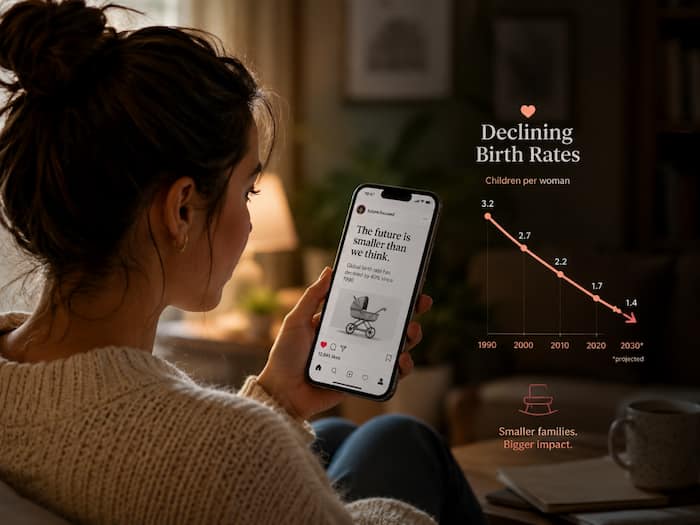
 iPhone and declining birth rates: Researchers think there may be a connection (Image: AI Generated)


Written By Divya
Can a smartphone influence how many children people have? It sounds like an unusual question. After all, when Apple launched the first iPhone in 2007, nobody imagined it would be discussed one day as being linked to falling birth rates. Yet, two recent studies suggest that smartphones and particularly the iPhone may have played a role in changing how people socialise, date, and even start families.  Also Read: Apple could launch revamped Apple Pencil lineup with M6 iPad Pro in 2027: Report
Before you blame your iPhone entirely, researchers are not saying smartphones are the only reason behind declining fertility rates. But they do believe the timing is worth paying attention to. Also Read: Is Tom Holland really holding the iPhone Ultra? Here's the truth
According to a study by the National Bureau of Economic Research, fertility rates in the United States remained relatively stable for decades before starting a noticeable decline around 2007 and yes, you spot it right – the same year when Apple introduced the first iPhone. Also Read: iPhone Ultra may match Samsung Galaxy Z Fold 8 Ultra in battery
Researchers looked at a unique period when the iPhone was available only through AT&T in the US. Since network coverage varied across regions, they compared areas with stronger access to the iPhone against those with limited availability. Their findings showed that birth rates, particularly among younger women, declined faster in places where iPhone access was higher.
The trend was most noticeable among women aged between 15 and 24 years.
The researchers believe smartphones may have indirectly changed people’s behaviour. As smartphones became a bigger part of daily life, people started spending more time online and less time socialising in person. Some studies also point towards reduced dating activity, changes in relationship patterns, and increased digital entertainment replacing face-to-face interactions.
Another possibility is access to information. Smartphones made it easier for young people to learn about contraception, reproductive health, and family planning options. In short, the phone itself is not reducing fertility. But the lifestyle changes that came with smartphones may be influencing personal choices.
Interestingly, another study examined data from more than 100 countries and noticed a similar pattern. Researchers found that teenage fertility rates began declining more rapidly around the same time smartphones became widely adopted. The trend appeared across countries with very different cultures, economies, healthcare systems, and social policies.
That led researchers to explore whether smartphones could represent a common global factor influencing fertility trends.
Of course, fertility rates are influenced by much more than smartphones. Rising living costs, expensive housing, career priorities, delayed marriages, stress, changing social norms, economic uncertainty, and a lot more. all play a role. Many countries, including India, China, Japan, South Korea, and several European nations, are already witnessing declining birth rates for a combination of reasons.

Not exactly. But researchers believe smartphones may have quietly changed how people spend their time, build relationships, and make life decisions. Whether that is enough to influence fertility rates globally remains a topic scientists are still trying to understand.

Don't Miss Out the Latest Updates. Subscribe to Our Newsletter Today!