
Written By Shubham Arora
Published By: Shubham Arora | Published: Jan 23, 2026, 12:05 AM (IST)


Written By Shubham Arora
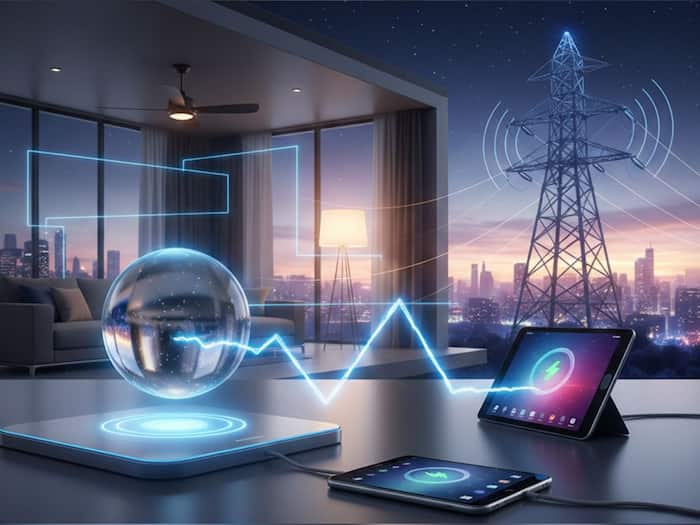
For most people, electricity has always meant wires. Cables in walls, chargers plugged into sockets, and power lines stretching across cities. In Finland, researchers are asking a simple but curious question: what if electricity did not always need a wire to move from one place to another?  Also Read: Using AC this summer? These tips can help lower your electricity bill
That question is at the centre of a series of experiments being carried out quietly by Finnish scientists. The work is not about replacing power grids or charging phones across rooms. Instead, it is about understanding whether electricity can be guided through air in controlled, useful ways. Also Read: Total Lunar Eclipse 2026 in India: When and how to watch it - check time, cities, and online streaming details
Researchers from institutions such as the University of Helsinki and the University of Oulu are combining several technologies to move small amounts of energy without physical connections. In these Finnish experiments, researchers are working with a mix of ultrasonic sound waves, lasers, and radio-frequency energy that already exists around us.
Instead of allowing electricity to move freely through the air, the focus is on control. The energy is guided along specific paths, which helps keep things controlled and easier to handle.
One approach researchers are testing is what they refer to as an “acoustic wire.” Simply put, powerful ultrasonic sound waves are used to shape the air. This creates a narrow route through which tiny electrical sparks can travel. There is no solid wire, but the sound waves act as a guide.
Lasers are also part of the setup in some cases, helping deliver very small amounts of energy or assisting with control and isolation. Alongside this, radio-frequency harvesting converts ambient electromagnetic waves into usable electricity, though only at very low power levels.
Despite how it may sound, this is not electricity floating freely across rooms. The power involved is small, the distances are short, and the systems need careful alignment. What Finnish researchers have demonstrated is controlled energy transfer, not unlimited wireless electricity.
The real achievement lies in showing that air can be shaped and used as a medium for guiding energy, rather than relying entirely on solid conductors.
This kind of wireless electricity makes the most sense in specialised situations. Sensors sealed inside machines, devices operating in hazardous environments, or medical implants that cannot be opened easily are all potential use cases.
Researchers are also studying how these energy fields interact with the human body, which is an important step before any real-world medical use.
For now, traditional cables are not under threat. Wireless electricity works best only over short distances and at very low power levels. Losses increase quickly as distance grows, making it unsuitable for homes or cities.

What Finland’s work shows is not a future without wires, but a future where wires are not always the only option.

Don't Miss Out the Latest Updates. Subscribe to Our Newsletter Today!