Written By Divya
Published By: Divya | Published: Apr 07, 2026, 06:21 PM (IST)
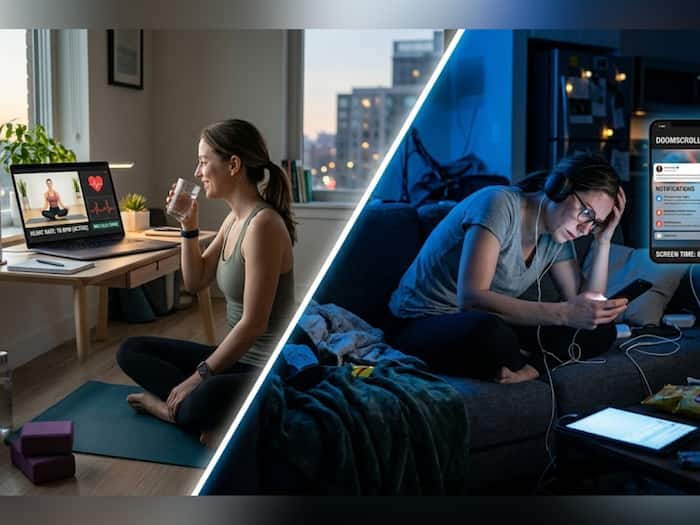
 More Screens, More Solutions? The Reality of Tech and Health


Written By Divya
Honestly, I think it’s a little bit ironic. We spend all day looking at screens and feel tired, distracted, and in some cases overly anxious, yet we use another app to fix that, such as meditation, sleep tracking, or even AI. So technically and ironically, technology is becoming the problem as well as the solution!  Also Read: OpenAI launches 'AI Safety Fellowship Program': Big opportunity for researchers and experts
The reality is, it’s not completely one way or the other. When it comes to screen time, it’s not as harmless as it appears. Let’s start talking about screens since we all face them throughout the day. Also Read: Google launches AI Edge Eloquent: Offline dictation app now available on iOS
Whether you’ve got a phone, laptop, or tablet, there are many different types of screens we need to face on a daily basis, and sadly, they also have repercussions for our bodies. Also Read: Can your smartwatch save your life? Health features that actually work #FitIndiaHitIndia
Think about it… haven’t you ever got a little sore in your eyes after a long day staring at a computer screen? Or the random headaches that come after you’ve been scrolling for a few hours at night before bed? Neither of these things is something you would just experience in your head.
Why is that? Because all of the research surrounding eye strain caused by blue light and whether or not it is harmful to your eyesight includes a lot of people basically telling you the blue light part is being blown way out of proportion. The real issue is much simpler than that. People aren’t using their computer screens against their actual vision, so when you use your computers for long periods of time, you may develop eyeglasses problems and eye strain, a report in the American Academy of Ophthalmology suggested.
The study suggests that staring at a screen constantly decreases your rate of blinking. When you’re not using a screen, you will blink approximately 15 times per minute, but while you are using a screen, your rate of blinking drops considerably. Because of decreased blinking, your eyes may experience dryness, blurred vision, or discomfort. Therefore, the problem is less about “screens are bad for you” and more about “we don’t get enough breaks from screens.”
Your eyes aren’t the only victims of excessive screentime… your sleep is affected as well. Blue light emitted from your devices at night usually slows down the production of melatonin, the hormone that helps us wind down. Thus, if you are using your devices before going to sleep, you may find yourself saying “just five more minutes,” and before you know it, it is already 2 AM! Well, we all have been there, and many are still there.
There is a simple solution to this, which even your own device provides. Using the night mode settings that help to reduce the amount of time you spend online before going to bed – these are all things we know to do but don’t consistently do. The mental aspect of this can complicate the situation.
Technology has made life easier in many ways, but it’s also made it harder to switch off. Constant notifications, endless scrolling, always being available, it adds up. That’s partly why mental health apps have seen such a rise. From guided meditation to breathing exercises, there’s an app for almost everything now. And to be fair, they do help, at least to some extent.
A research paper titled “The efficacy of mindfulness apps on symptoms of depression and anxiety: An updated meta-analysis of randomised controlled trials,” suggests that mindfulness apps can reduce symptoms of anxiety and depression, but the improvement is usually small. Not life-changing, but noticeable enough for some people.
Which makes sense. These apps are easy to access, always available, and don’t require appointments. But at the same time, they’re not a complete replacement for real therapy or deeper support. Depending on how you look at it, the apps can be either convenient or disconnected.
All of these types of apps are designed to be self-directed. You download the app, choose a session, possibly think it helps you for a few minutes… but there are no other people’s opinions on how well you’re doing. No feedback, no interactions, no conversations. So the apps may fall short where meditation or therapy in person usually provides a benefit, due to the human connection.
Most apps are built for mass use, therefore the majority of people are reached. However, they will not receive the same level of care as with meditation or therapy. The third thing I’ve come across that is intriguing to researchers is that some participants reported using a health-related app to feel as if they were taking control of a situation, even though there was little to no actual change at all.
So are we creating solutions to a problem, or creating more problems? This is where I feel this is a bit of a vicious cycle: You use screens, then receive feelings of tiredness, then use an app to alleviate the tiredness, and here you consume more screen time.
It’s easy to say “reduce screen time” or “don’t rely on apps,” but that’s not very practical anymore. Technology is part of daily life. Work, communication, even basic tasks, everything runs through it. So maybe the better approach isn’t to avoid it, but to use it more consciously.
Take breaks without needing an app to remind you. Use tools that actually help, not just ones that feel productive. And more importantly, know when to step away. Because right now, technology is doing both, helping us manage our health, while also quietly affecting it.

And we’re still figuring out where that line really is.

Don't Miss Out the Latest Updates. Subscribe to Our Newsletter Today!