Written By Divya
Edited By: Divya | Published By: Divya | Published: Mar 28, 2026, 11:15 PM (IST)

 Doomscrolling and Dopamine: Why your brain keeps wanting more (and more)


Written By Divya
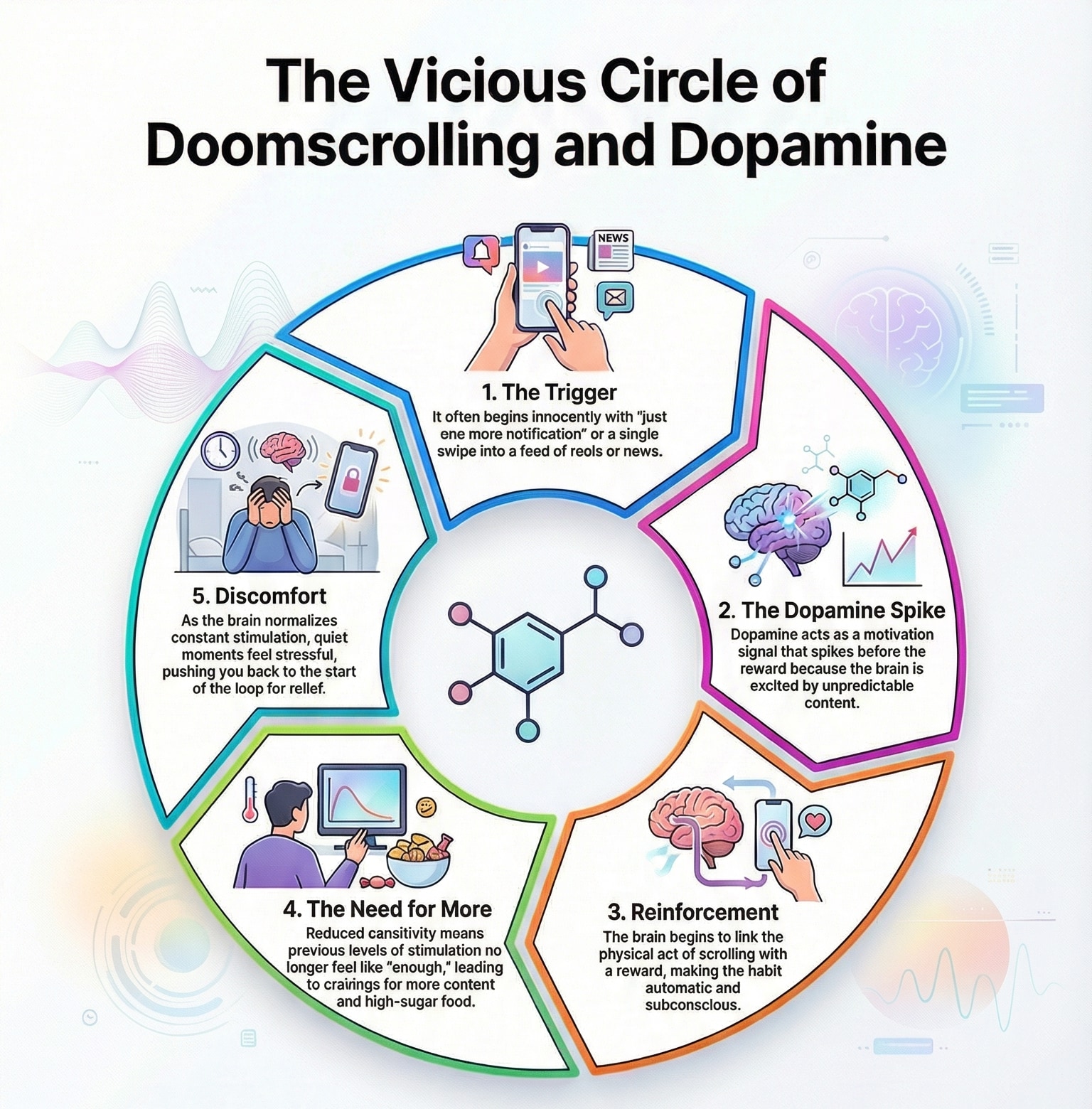
Honestly, it starts unknowingly. You pick up your phone to check one notification, and before you know it, you’re 40 minutes deep into reels, news updates, or endless scrolling. Somewhere between “just one more video” and “last post,” your brain quietly rewires itself. But you are not alone! It happens with almost everyone, including me.  Also Read: Social media addiction case: Meta, Google face liability verdict
This habit even has a name – doomscrolling, which isn’t just about time wasted but how our brains are responding to constant stimulation and how that response is spilling over into everything else, from what we eat to how we focus. What lies behind it is dopamine, a neurotransmitter which is generally called the “pleasure chemical,” but to be precise, it is the brain’s motivation and reward signal. The more we scroll, the more we train our brains to expect quick, frequent rewards. And over time, that expectation doesn’t stay limited to our screens, it starts affecting real-life behaviours too. Also Read: Snapchat adds AI tool that turns your photos into short video clips: How it works
Every swipe, every like, every new post – it all feels small, almost harmless. But each of these actions gives your brain a tiny hit of silent victory. And that’s the point. The brain doesn’t just enjoy rewards, but it gets more excited by rewards it can’t predict. That unpredictability is what keeps you scrolling longer than you planned. Also Read: Nvidia CEO Jensen Huang claims AGI is achieved: Experts react to bold statement
Dopamine, in this case, isn’t just about feeling good. It spikes even before the reward arrives, when your brain expects that the next swipe might be interesting. That’s exactly how social media feeds are built. Over time, this turns into a pattern. The brain starts linking scrolling with reward, which slowly builds into a habit without you even noticing.
Research around catecholamines, neurotransmitters like dopamine, suggests how deeply they are tied to brain function. A study titled “Design, Synthesis, and Biological Evaluation of Catecholamine Vehicle for Studying Dopaminergic System” notes that disruptions in dopamine pathways are associated with conditions like anxiety, depression, and neurodegenerative diseases. Doomscrolling may not directly cause these conditions, but it operates within the same reward and motivation systems, quietly influencing how they behave over time.
Here’s where things get more interesting and… concerning. The same dopamine-driven loop that keeps you scrolling can influence other behaviours, especially eating. Studies in behavioural neuroscience suggest that repeated exposure to high-reward stimuli can reduce sensitivity over time. In simple terms, what once felt satisfying no longer feels “enough.”
So the brain starts seeking more content, and even more food (yes, that desert and junk food). This is why doomscrolling often pairs with mindless snacking. You must have noticed that the quiet moments start to feel uncomfortable, even stressful. And that discomfort takes us back into the loop – scrolling, eating, repeating.
And that reduced attention span? Short-form content trains the brain to process information quickly, slower tasks like reading, working, or even having a conversation start to feel effortful. Even cognitive research shows that frequent task-switching reduces the brain’s ability to sustain focus over time. And again, dopamine plays a role here. The brain begins to prefer high-reward, low-effort activities over anything that requires sustained attention.
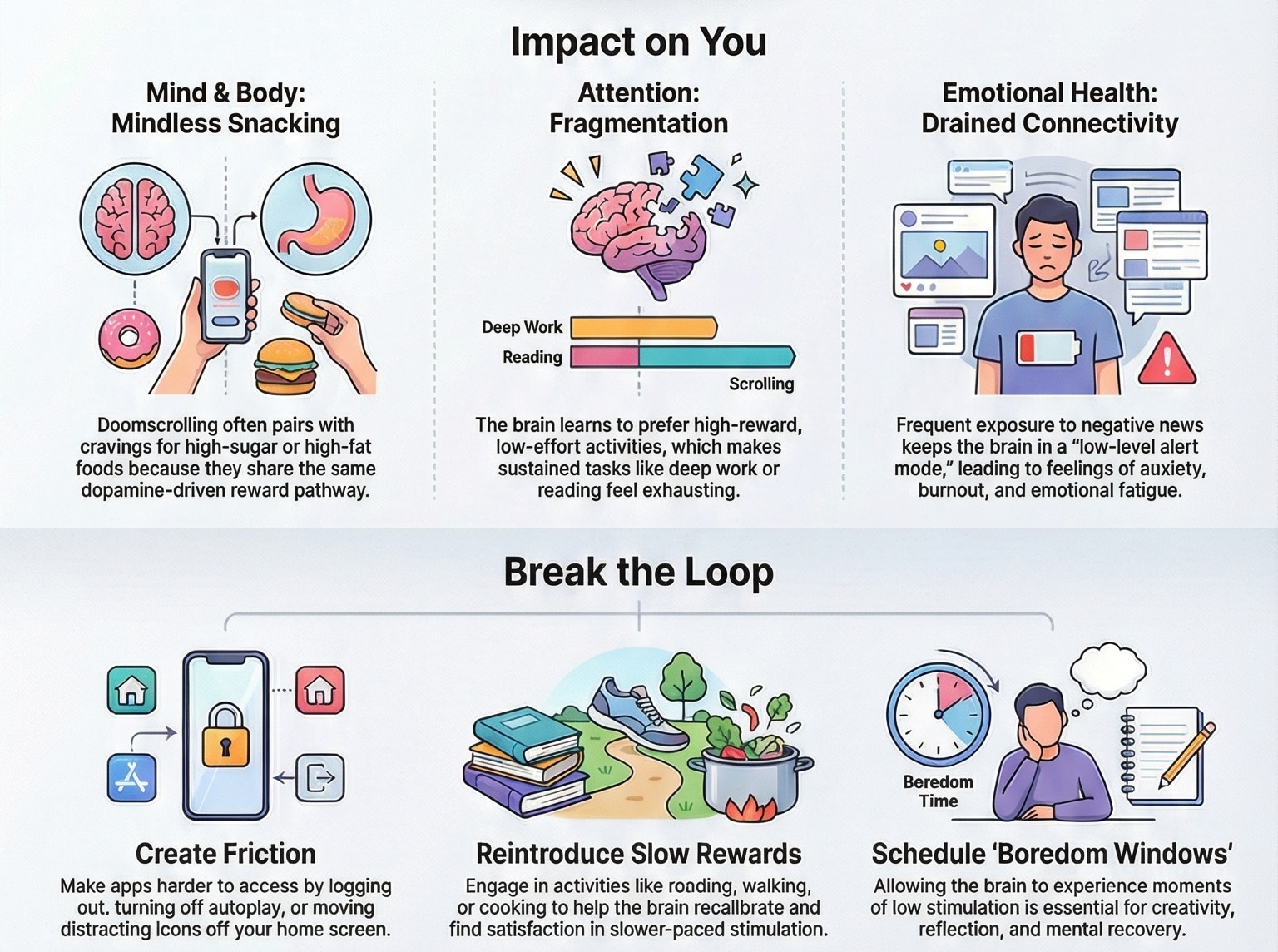

Reality? You can’t eliminate dopamine! It’s essential for survival. But you can balance it based on how your brain responds to rewards. Here’s what actually helps to keep our motto alive #HumFitTohIndiaHit:

Don't Miss Out the Latest Updates. Subscribe to Our Newsletter Today!