
Written By Deepti Ratnam
Edited By: Deepti Ratnam | Published By: Deepti Ratnam | Published: Feb 04, 2026, 02:41 PM (IST)



Written By Deepti Ratnam
Online gaming has grown rapidly in India over the past few years, especially the trend grew after the COVID-19 pandemic, and pushed millions of children and teenagers stay indoors. What started as a hobby has now turned into a deadly scenario in the country, and the recent tragic incident in Ghaziabad has left everyone wondering the level of impact online gaming is having on children. In distressing news, three minor sisters reportedly died after jumping from their 9th-floor apartment. What caught our attention is the involvement of a ‘K-Task Game’ or a ‘Korean Game’ that’s behind their suicide.
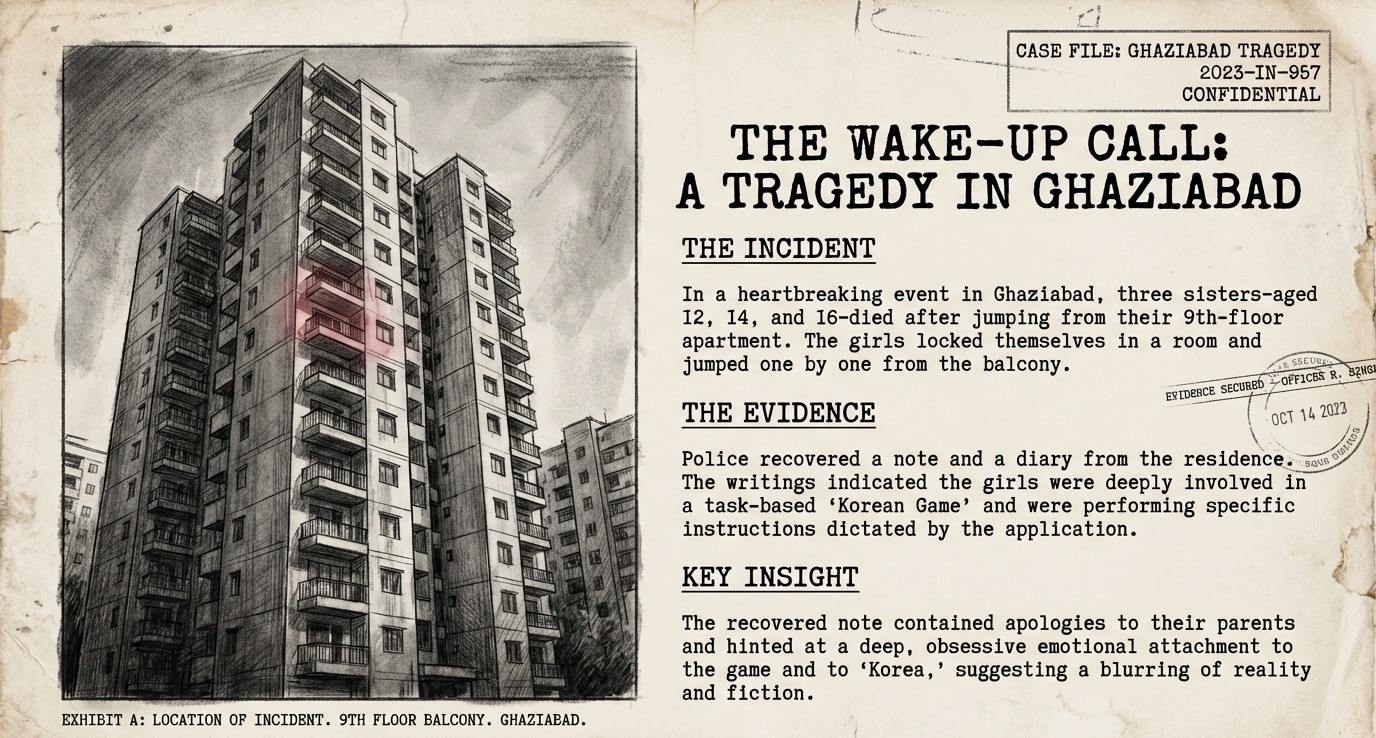
A tragic incident happened yesterday in Ghaziabad, wherein three sisters aged 12, 14, and 16 jumped from their apartment, leaving behind a note and a diary that pointed toward an online Korean game. As per their diary, they were deeply involved in an online task-based ‘Korean game’ and were performing tasks as instructed by the game.
As per reports, all three sisters were spending long hours playing the online game since the COVID-19 pandemic. Police officials mentioned that the girls were irregular in their studies and also not attending school. This led them to be increasingly withdrawn from everything.
On the morning of the incident, girls locked themselves inside a room and jumped one by one from the balcony. The police and ambulance were called immediately, but couldn’t save them. Afterwards, a note was recovered from the house, apologizing to their parents about committing suicide and hinting at their emotional attachment to the game and to Korea.
The police are examining the diary and the level of involvement all three girls had with the game. Nevertheless, there’s no conclusion as of now and the case has reopened a difficult conversation around online games and their deadly challenges. It has also encouraged us to understand how the mental health of teenagers is affected by the usage of these online games.
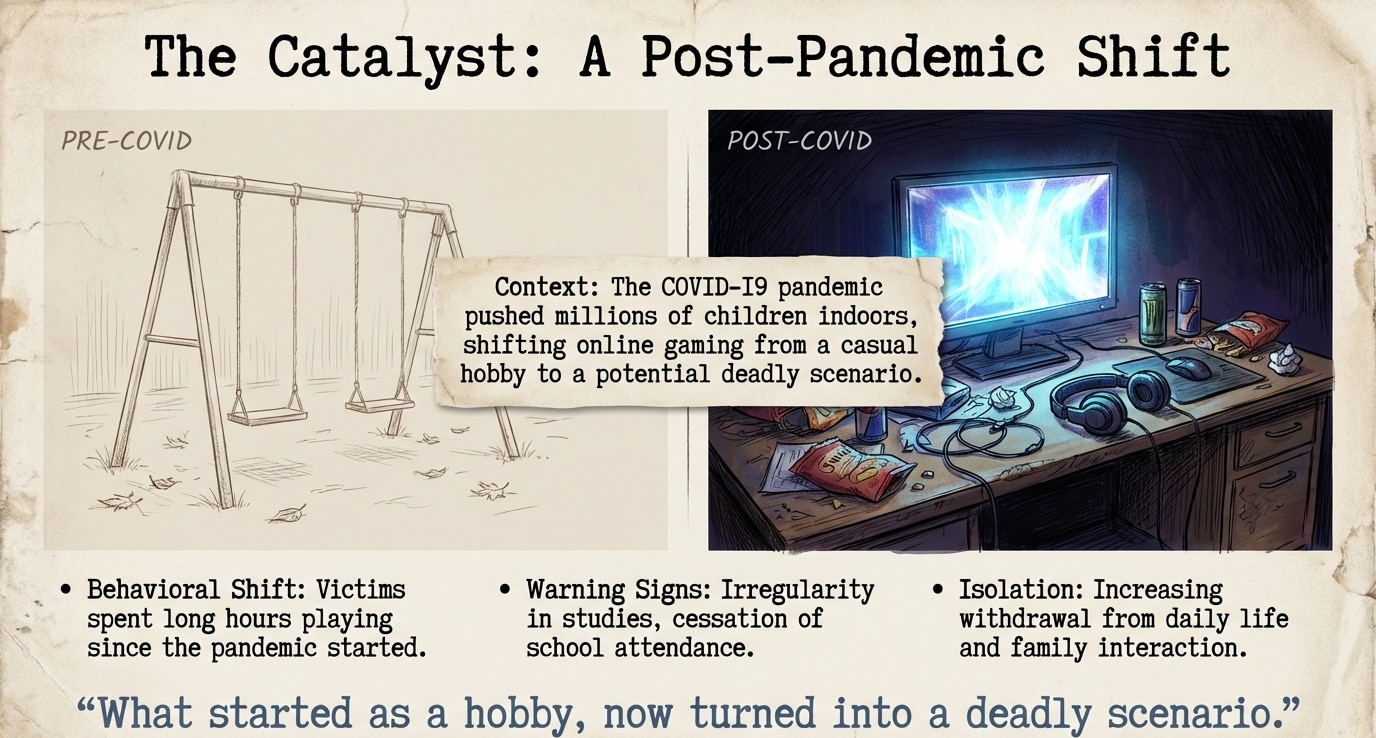
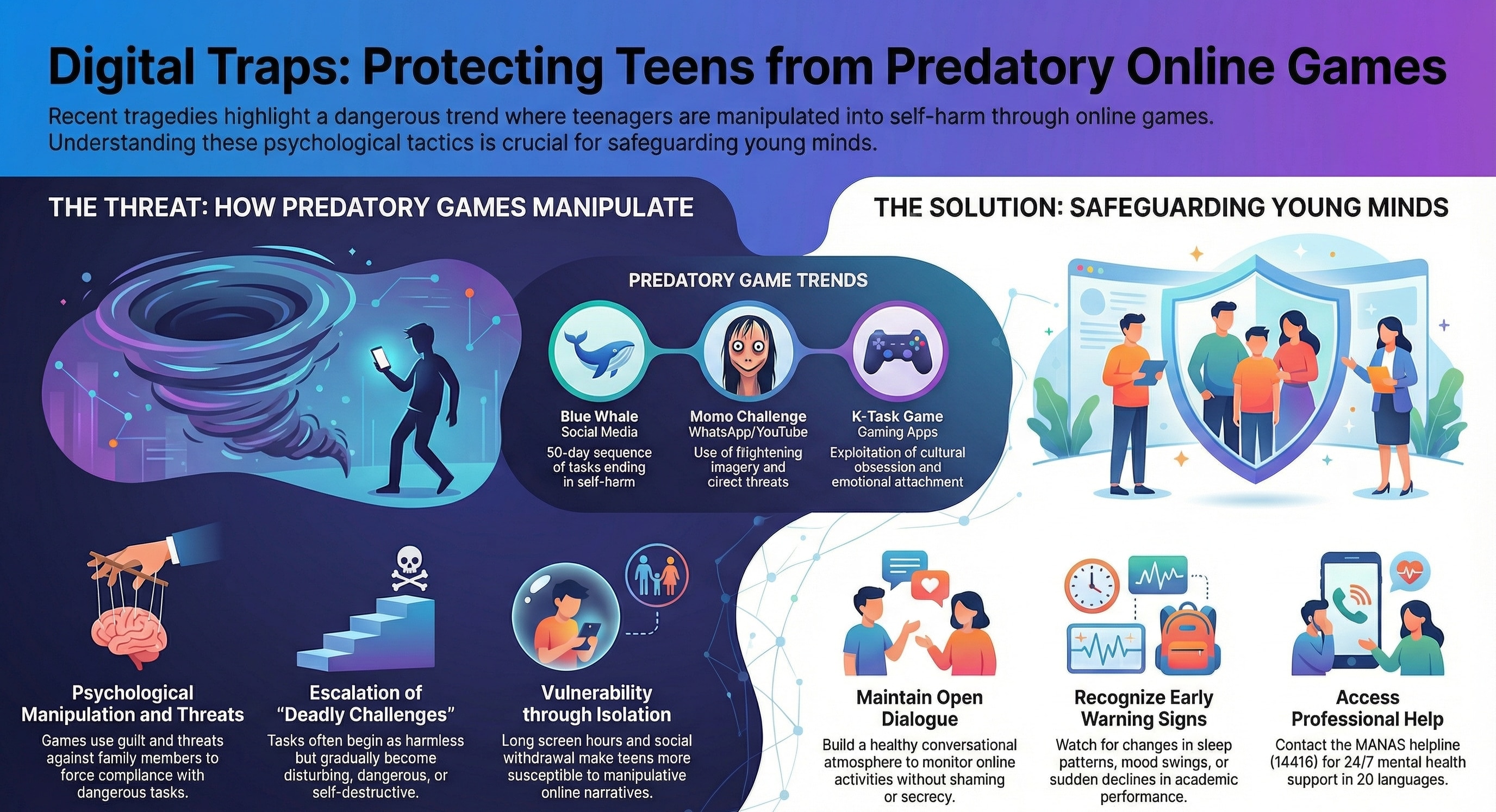
To recall, this is not the first time that an online game has forced teens to indulge into self-harm. In the past, games like Momo Challenge and Blue Whale Challenge created panic across countries like Brazil, Egypt, the United States, and India too. These so-called games not just pushed participants to complete deadly tasks, but also forced them to commit suicide. The tasks often started as harmless, but gradually became disturbing and dangerous.
Blue Whale
It is not long back when Blue Whale Challenge affected teens in India during the time of the COVID-19 pandemic. The game has 50 tasks to complete over 50 days. The last task demanded for self-harm. Nevertheless, later investigation suggested that many reports were fabricated or exaggerated or were unverified, the fear it created was unreal. Reportedly, teenagers across the world were participating in the Blue Whale Challenge and interacting with the content that glorified harm, emotional manipulation, trauma, distress, torment, and suicide.
Momo Challenge
Another deadly game that came into light was the Momo Challenge and how it deeply affected young minds. The challenge reportedly gained widespread popularity via WhatsApp and YouTube, where children and teenagers were exposed to frightening images and messages. These messages and explicit images were sent from an account called ‘Momo.’
Participants in this game were instructed to carry out a series of dangerous tasks, including suicide, self-harm, and many others. If refused to perform the tasks, teens were threatened with harm to their family members. However, many reports later suggested that the game was basically a hoax to create panic among people, but we can’t refuse the fact that its psychological impact was very real. It increased anxiety and fear among parents about the fact that a game suggests several ways of self-harm and distress among their children. It happened across different countries, including India and forced parents and authorities to take online safety more seriously.
Nevertheless, what mattered most was not that the game existed as described, but how vulnerable minds could react to the risky content and games.
Teenagers are one such crowd in our society who are at a vulnerable stage as their emotional and cognitive development is still in progress. They find difficulty in understanding what’s right and what’s wrong and this is the main reason they can be easily manipulated into something wrong. They often seek validation and this is where online games find a hole to exploit these needs. Task-based games like Momo Challenge, Blue Whale, or Korean-Task Games create a sense of achievement and fear of exclusion. These games embed into the minds of teens and challenge them to perform something demanding.
These games often use emotional manipulation, forcing players to feel guilty or face consequences. They forced players toward extended screen time, lack of supervision, and isolation, and hence, the effects grew stronger and stronger. Over time, the player not just loses touch with friends and family, but in some extreme cases it can also force them to think the game is more real as compared to the outside or real world.
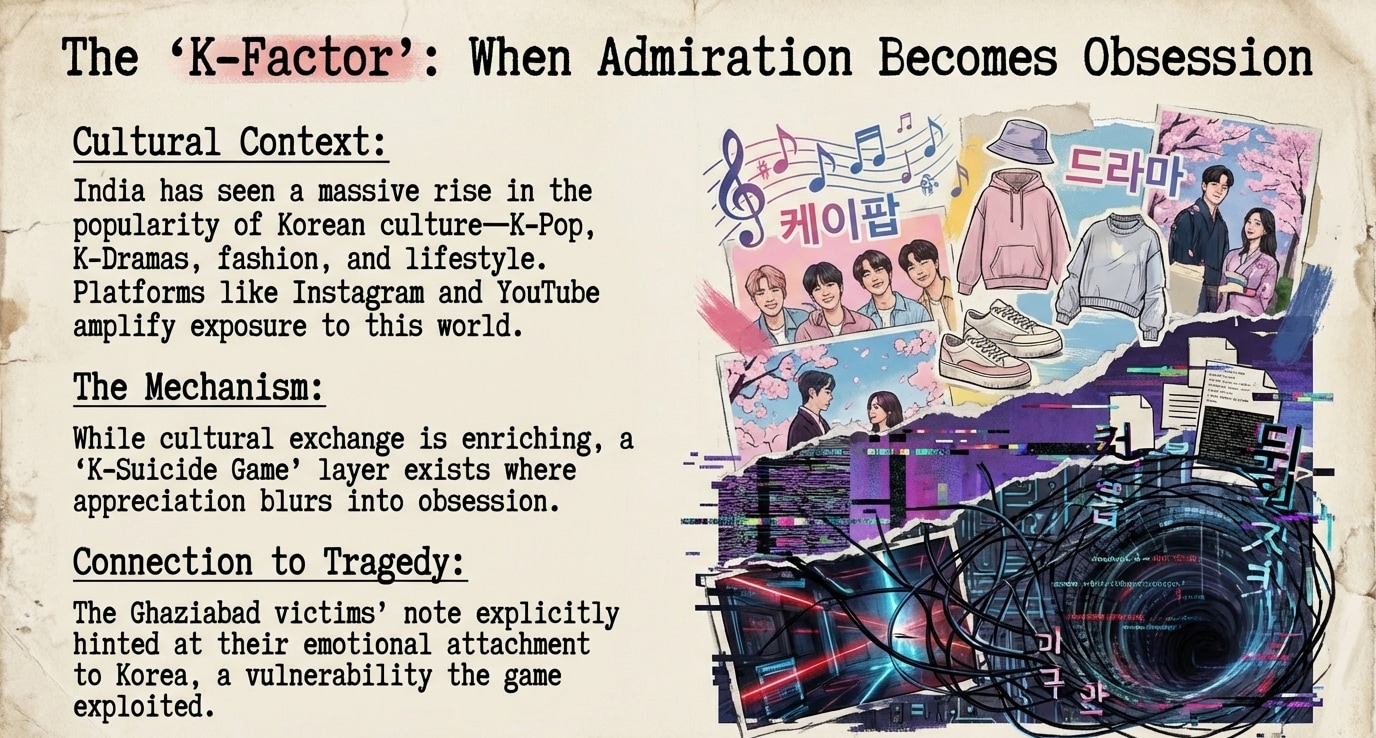
Another important layer in our today’s ‘K-Suicide Game’ is the popularity of Korean culture in India. The country has become obsessed with Korean dramas, stories, fashion, K-pop bands, lifestyle, and most importantly their skin. All these together have a massive following base in India and platforms like Instagram, YouTube, and gaming apps are amplifying the exposure to the Korean world.
While we understand the importance of cultural exchange and take it as a positive and enriching experience, we can’t turn away when the lines between fantasy and reality blur. These games and cultural impact can force young users to disconnect from their real-life connections and develop deep attachments to fictional worlds, characters, and online communities. Without guidance many a time this connection can turn into an obsession and lead to the tragic incident that happened in Ghaziabad.
This tragedy underlines the need for awareness rather than panic.
Do’s:
One of the essential and foremost things that a parent can do is build a healthy conversational atmosphere at home. They should openly talk and monitor about children’s online activities along with monitored screen time. Healthy routines should be encouraged at home and school. The focus should be on real-world friendships rather than online dependency. It is necessary to take professional help as soon as you notice emotional withdrawal, anxiety, or obsession.
Don’ts:
A negative impact that a child feels starts at home when you dismiss his or her behavior as ‘harmless or just a phase.’ Make sure you don’t shame them or apply sudden strict bans as it can be pushy and force them into secrecy. Don’t ignore changes in their behavior, while sleeping, their mood changes, and academic performance.
The recent suicide incident in Ghaziabad is not just a family tragedy, but a warning. A warning about how technology while becoming a perfect solution for our needs is also responsible to protect our young minds. We can increase awareness, conversation, and emotional support so that the strongest and most advanced tools that we have today don’t turn into a space that silently becomes vulnerable for our teenagers.

MANAS: It is a free 24/7 mental health support initiative by Indian government. Call 14416 to connect with a counselor. Available in 20 languages.

Don't Miss Out the Latest Updates. Subscribe to Our Newsletter Today!