
Written By Shubham Arora
Published By: Shubham Arora | Published: Apr 28, 2026, 01:25 PM (IST)
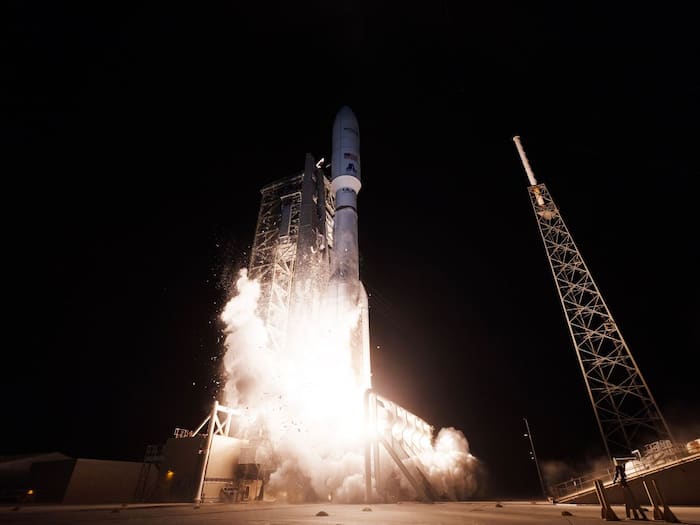
 Atlas V rocket lifts off carrying 29 Amazon internet satellites during a night launch.


Written By Shubham Arora
The Atlas V, operated by United Launch Alliance, has completed another launch for Amazon, carrying a fresh batch of internet satellites into space. The mission, referred to as Amazon Leo 6, is part of Amazon’s larger plan to build a satellite-based broadband network in low Earth orbit.
The rocket lifted off from Cape Canaveral Space Force Station in Florida at 8:53 p.m. EDT on April 27 (6:23 a.m. IST on April 28). It was a night launch, and because of that, the rocket’s trail was visible across several parts of the US, with sightings reported from states along the East Coast.
This launch carried 29 satellites, all meant for Amazon’s low Earth orbit internet constellation. The company is working on a network that will eventually include more than 3,000 satellites, aimed at providing internet access in areas where connectivity is still limited.
This was the sixth Atlas V mission linked to Amazon’s satellite programme. Overall, only a small portion of the planned constellation has been deployed so far, which means many more launches are expected over the next few years.
The satellites were released in phases rather than all at once. Deployment started roughly 20-21 minutes after liftoff and continued over multiple stages, ensuring each satellite was placed correctly in orbit.
One of the key details from this mission is the payload weight. The Atlas V carried a payload of around 18 tonnes in this mission, which is tied with the heaviest load it has handled so far.
To lift something this heavy, the rocket was fitted with five solid rocket boosters. These boosters help generate the extra push needed during liftoff, especially when the payload is on the heavier side.
This is not the first time Atlas V has carried such a load. A previous Amazon mission on April 4 also launched 29 satellites and set the same payload record.
Amazon’s satellite network, previously known as Project Kuiper, is designed to compete with other space-based internet services. The idea is to create a global network of satellites that can deliver broadband connectivity directly from space.
To build this network, Amazon will need more than 80 launches in total. So far, only a limited number of missions have taken place. Apart from ULA, other companies like SpaceX and Arianespace are also involved in launching these satellites.
Because the launch happened at night, it stood out more than usual. The rocket’s bright trail was visible across several states, including parts of South Carolina, North Carolina, and even areas farther north.

As it climbed higher, parts of the rocket started separating, including the boosters and the outer cover around the satellites. That’s a routine part of any launch and helps the rocket get lighter as it continues upwards.

Don't Miss Out the Latest Updates. Subscribe to Our Newsletter Today!