
Written By Shubham Arora
Edited By: Shubham Arora | Published By: Shubham Arora | Published: Jan 23, 2026, 03:07 PM (IST)
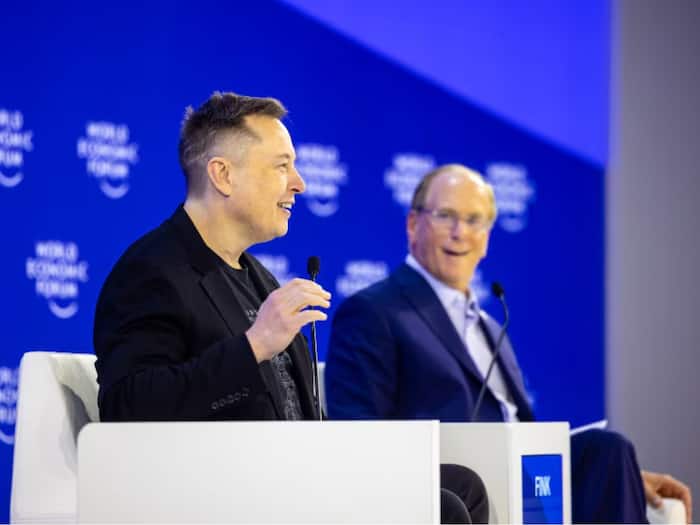
 Image: World Economic Forum


Written By Shubham Arora
Elon Musk finally showed up at Davos. For someone who has often mocked the World Economic Forum as a gathering of disconnected elites, the moment stood out. This was Musk’s first-ever appearance on the WEF stage, and he didn’t walk in alone. Sitting across from him was Larry Fink, one of the most influential figures in global finance.  Also Read: Adobe brings AI assistant to Photoshop and new Firefly editing tools
The setting mattered. Davos is where governments, investors, and corporate leaders shape long-term economic narratives. Seeing Elon Musk there, sharing a stage with the head of the world’s largest asset manager, felt like two different power centres briefly overlapping. Also Read: YouTube’s AI tool to detect deepfakes now available to journalists and government officials
Fink opened the session by calling Musk a “great friend” and spoke about learning from him over the years. He brushed aside the controversies that often surround Musk and focused instead on his long-term vision. It was a softer introduction than many expected, especially given Musk’s complicated public image. Also Read: Google’s Gemini Embedding 2 lets AI understand text, images and video together
Musk, true to form, treated the moment casually. Just before stepping on stage, he posted on social media asking what he should say at Davos. The post landed the way many of his tweets do: half joke, half signal that he was doing things his own way, even here.
Much of the conversation turned to Tesla. Musk said the company could receive regulatory approval in Europe and China as early as next month for its driver-supervised Full Self-Driving system. The timing matters. Tesla has been leaning more heavily on software and subscriptions as vehicle sales growth slows.
Europe, in particular, has been a tough market for automated driving features due to strict safety rules and fragmented regulations. Musk acknowledged the challenge but sounded confident. He also reiterated earlier comments that future versions of FSD could move closer to unsupervised driving, something regulators continue to watch closely.
Musk also used the Davos stage to talk about Tesla’s humanoid robot project. He said the company now expects to sell these robots to the public by the end of next year, later than earlier timelines. His pitch was practical rather than flashy: robots that could help care for elderly parents, watch over children, or manage household tasks.
He added that the Optimus robots would start handling more complex tasks later this year. In the same breath, Musk predicted that AI systems could surpass human intelligence within the next year or so, a claim that drew quiet attention across the room.

Musk’s appearance at Davos wasn’t about policy announcements or immediate deals. It was symbolic. Sharing a stage with Larry Fink at the world’s most influential economic forum marked a rare moment where Silicon Valley ambition and Wall Street capital openly aligned, even if just for a conversation.

Don't Miss Out the Latest Updates. Subscribe to Our Newsletter Today!