Written By Divya
Published By: Divya | Published: Dec 19, 2025, 11:35 PM (IST)


Written By Divya
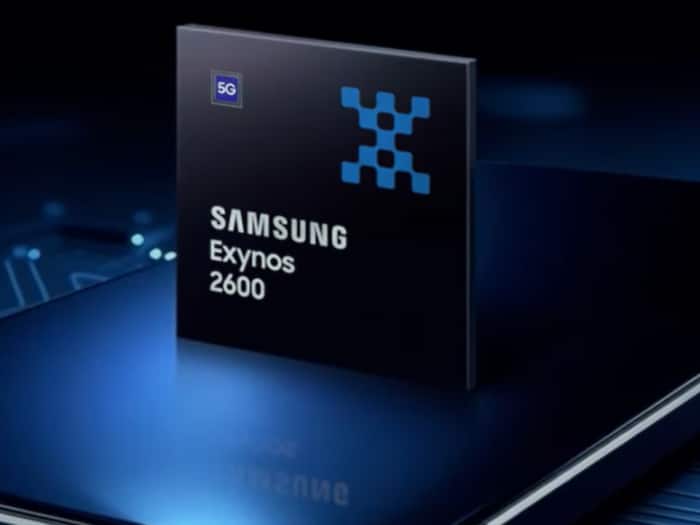
Samsung has taken an early lead in the next phase of mobile chipmaking. The company has officially unveiled the Exynos 2600, calling it the world’s first 2nm mobile processor built using its Gate-All-Around (GAA) manufacturing process. With this move, Samsung has crossed the 2nm milestone ahead of Apple, which is widely expected to enter the space sometime in 2026.  Also Read: Latest renders left no room for guess ahead of Samsung Galaxy S26 launch; Check here
The new chip is positioned as Samsung’s next flagship processor and is expected to power select models in the upcoming Galaxy S26 series. However, the final details are unknown. Also Read: 7 best budget ANC earbuds under Rs 5,000
Of course, it is the 2nm process! Compared to current 3nm chips, moving to 2nm allows more transistors to fit into the same space, while improving performance and reducing power consumption. Samsung says its GAA-based process, which helps the chip deliver better efficiency without compromising speed.
Exynos 2600 uses ARM’s latest CPU cores and supports newer instructions. According to Samsung, CPU performance sees up to a 39 percent boost, while AI workloads handled by the NPU are claimed to be more than twice as fast compared to the previous generation.
On the graphics side, the chip features Samsung’s latest Xclipse GPU, which is said to significantly improve gaming performance. Samsung claims up to double the graphics performance and as much as 50 percent better ray tracing, making it more capable for high-end mobile gaming.
AI is clearly a major focus this time. The Exynos 2600 is designed to handle larger on-device AI models more efficiently, enabling faster image processing, smarter camera features, and better generative AI tasks, Samsung mentioned.
Apart from this, heat management is another important aspect. One long-standing criticism of Exynos chips has been heat management. To tackle this, Samsung has introduced a new thermal solution called Heat Path Block (HPB). This approach improves heat dissipation using specialised materials.
Apple is expected to move to 2nm chips in late 2026, using TSMC’s 2nm process for future iPhone and possibly Mac processors. While Apple’s chips are still highly competitive, Samsung’s announcement gives it a timing advantage – at least on paper.

Whether that lead translates into real-world gains will only be clear once devices with Exynos 2600 reach users’ hands.

Don't Miss Out the Latest Updates. Subscribe to Our Newsletter Today!