
Written By Deepti Ratnam


Written By Deepti Ratnam
Edited by Deepti Ratnam |Published: Aug 10, 2026, 01:52 PM (IST)
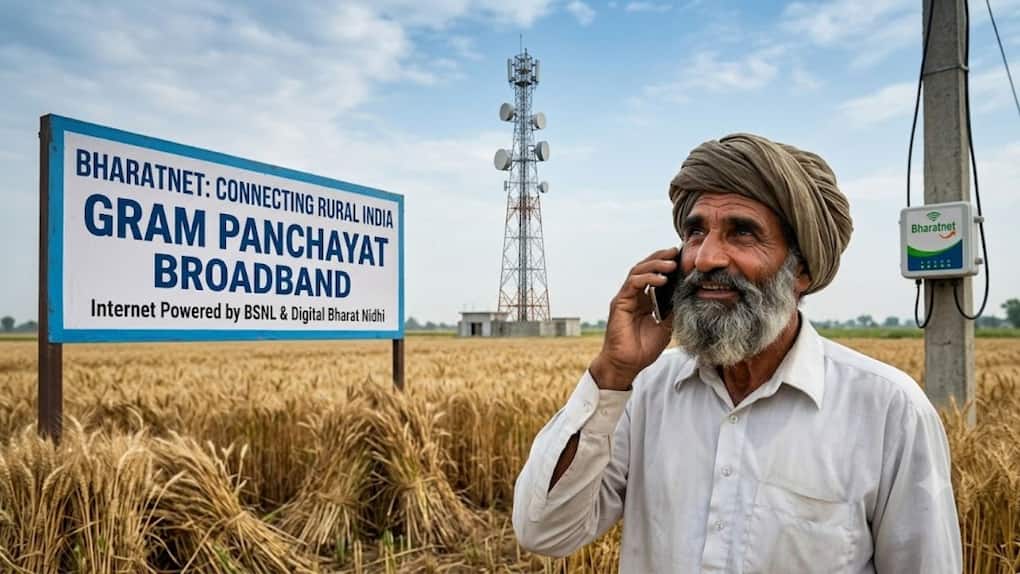
 haratNet rollout under PM Modi comes under scanner as panel flags major gaps
India’s BharatNet rural broadband initiative is facing implementation inconsistencies, as the Parliamentary Standing Committee has raised concerns about the uneven landscape across the country and urged a thorough audit of the project.
The Standing Committee on Communications and Information Technology has urged the Department of Telecommunications to audit the performance of BharatNet comprehensively, on a state-wise and implementation model-wise basis. The exercise should help identify bottlenecks and ensure timely broadband connectivity for all Gram Panchayats, said the panel.
As of 28th February, 2026, BharatNet Points of Presence (POPs) were available at 78,899 Gram Panchayats, according to information provided by the Department of Telecommunications. This is much less than the 2.64 lakh Gram Panchayats in the country.
A PoP is a Local Network Node where broadband service can be extended to homes, institutions and other users.
The panel pointed out that while some good infrastructure has been built in BharatNet, the number of operational Gram Panchayats is not yet the target of reaching universal coverage as programme.
The committee added discrepancies in implementation between states and project models. The slow tempo signals problems in the planning, coordination, and execution, it said.
The committee has requested the department of telecommunications to do a thorough performance audit both on the level of the individual states and on different implementation models.
It has also requested a new and time-bound plan to enable connectivity to all Gram Panchayats. The panel wants clear accountability to be assigned for completing the remaining work.
The action is intended to determine why infrastructure hasn’t translated into a universal operational connectivity and where delays are happening.
The government also has invested heavily in the infrastructure needed to deliver broadband connectivity for rural areas.
The net length of optical fibre cable laid under BharatNet as on February 28, 2026, is estimated to be some 7.19 lakh kilometres. The network is mainly based on optical fibre, which is used in transmitting internet data at high speeds over long distances.
The government had also released Rs 40,635 crore from Digital Bharat Nidhi for BharatNet Phase-I and Phase-II till the same period.
Digital Bharat Nidhi is a specific fund to promote the growth of telecom services, including in rural and unserved areas.
The Parliamentary panel also raised concerns about the utilisation of the BharatNet infrastructure that has already been created.
The department of Telecommunications told the committee that as of February 28, 2026, the BharatNet had 9,48,237 active Fibre-to-the-Home (FTTH) connections. All these connections were in rural areas.
FTTH technology is one providing broadband services directly to customers’ premises using optical fibre.
The committee noted that use of the infrastructure was not as high as it could be despite the large amount of fibre installed and government funding. The advantages of digital connectivity have yet to fully permeate rural and remote communities, it said.
Based on this, the panel has suggested that more efforts be made to expand FTTH connections and better utilize the network.
In October 2011, the Union Cabinet had sanctioned BharatNet as the National Optical Fibre Network. Later, it was expanded to BharatNet with the aim of connecting Gram Panchayats through broadband connectivity throughout India.
It was a significant component of Govt’s Digital India program. In December 2017, BharatNet Phase-I was completed and Phase-II was approved in July 2017.
The updated uses of the Parliamentary panel reveal that construction of fibre infrastructure is just one aspect of the issue. Making the network work and accessible to rural households and institutions is also crucial.

The proposed state-wise audit and a time-bound roadmap may be useful to find out the underlying reasons of the imbalanced rollout and enhance the utilisation of the infrastructure completed so far under BharatNet.


