Written By Divya
Edited By: Divya | Published By: Divya | Published: May 19, 2026, 10:39 PM (IST)
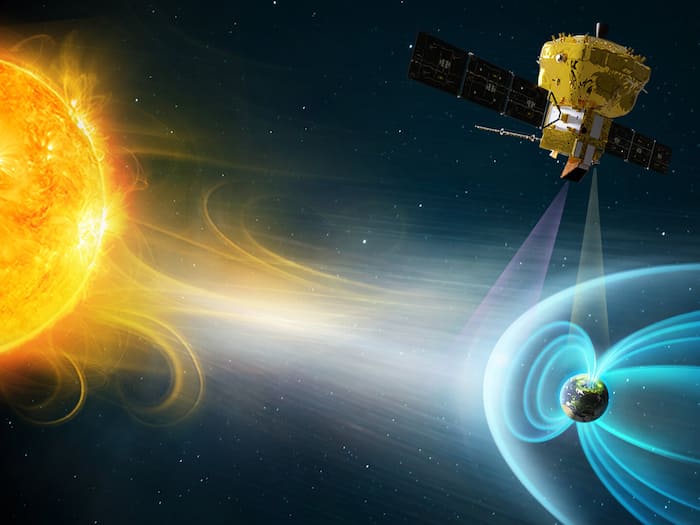
 China and Europe Launch Mission to Study Earth’s Magnetic Shield (Image Credits: ESA)


Written By Divya
The Sun gives us light, warmth, and quite literally the conditions needed for life. But at the same time, it is constantly throwing charged particles, plasma, and magnetic energy into space. So why does Earth not get damaged by all of it? That’s exactly what a new joint mission between the European Space Agency and the Chinese Academy of Sciences wants to understand better.  Also Read: Meet NASA's Artemis III crew: The astronauts preparing for the next Moon mission
The mission, called SMILE, short for Solar wind Magnetosphere Ionosphere Link Explorer, has now launched aboard a Vega-C rocket from French Guiana. And interestingly, it may help scientists finally capture the clearest view yet of how Earth’s magnetic shield reacts to the Sun in real time. Also Read: NASA astronauts may soon wear Prada on Moon missions
One of the biggest reasons life exists on Earth is because the planet has a strong magnetic field called the magnetosphere. Think of it like a giant invisible bubble surrounding Earth. It protects us from harmful charged particles and solar radiation coming from the Sun. Without it, the atmosphere could slowly erode away, and conditions on Earth would look very different. Also Read: Solar flare alert: NOAA issues G3 storm watch after solar eruption - what it means for India
But the magnetosphere is not static. It constantly changes shape and reacts depending on solar activity. That reaction is exactly what SMILE wants to observe closely.
The Sun regularly releases powerful eruptions like solar flares and coronal mass ejections. When these interact with Earth’s magnetic field, they create what scientists call space weather. Sometimes that interaction only creates beautiful auroras or northern lights. But stronger solar storms can affect:
Scientists say understanding these interactions better could help improve future space weather forecasting systems.
Previous missions have studied parts of the magnetosphere before. But SMILE is expected to provide something much broader — a full X-ray view of how Earth’s magnetic shield responds to solar wind. This will reportedly make it the first mission capable of imaging these interactions in real time.
The spacecraft carries four scientific instruments, including a Soft X-ray Imager and an ultraviolet aurora imager that will continuously observe auroras for long durations. In simple words, scientists may finally get to “watch” Earth’s protective bubble reacting live to solar activity.
The mission may be joint between Europe and China, but the UK has also contributed heavily to its scientific instruments and technology. British researchers are leading parts of the mission science, especially the Soft X-ray Imager. Several European countries also contributed hardware, detectors, software systems, and spacecraft technologies.

What makes SMILE important is that the findings could have a real-world impact. Modern life depends heavily on satellites, internet infrastructure, navigation systems, and communication networks. Severe solar storms have the potential to disrupt many of them.

Don't Miss Out the Latest Updates. Subscribe to Our Newsletter Today!