Written By Divya
Published By: Divya | Published: Jun 01, 2026, 02:24 PM (IST)
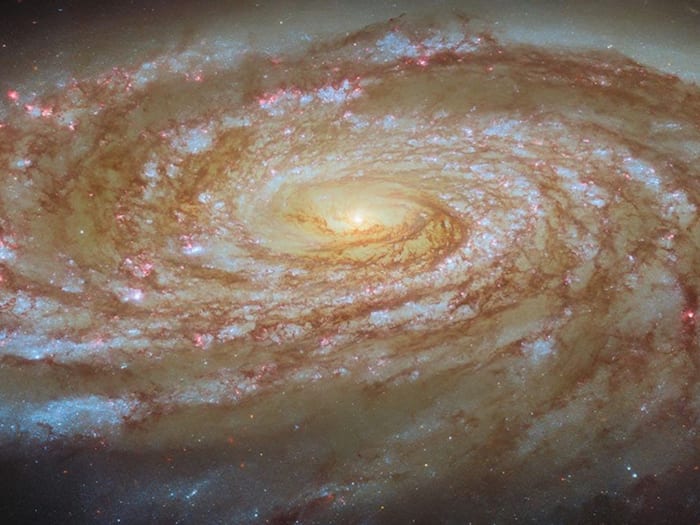
 Galaxy M88 With Giant Black Hole (Image Credits: NASA)


Written By Divya
NASA has recently released an image of Messier 88 (M88) captured by the Hubble Space Telescope. It is a spiral galaxy located around 63 million light-years away from Earth. It is also known as NGC 4501, which lies in the constellation Coma Berenices and is part of the Virgo Cluster, a massive collection of more than a thousand galaxies bound together by gra jivity.  Also Read: Meet NASA's Artemis III crew: The astronauts preparing for the next Moon mission
The image shows the well-defined spiral structure of the M88; however, astronomers are more interested in what is at its centre. It is a supermassive black hole, and NASA estimated it to be about 100 million times more massive than the Sun. Also Read: NASA astronauts may soon wear Prada on Moon missions
NASA M88 is classified as an active galaxy. In simple words, it carries a supermassive black hole at its centre that is actively consuming surrounding gas and dust. Astronomers estimate that this black hole is about 100 million times more massive than the Sun. Also Read: NASA confirmed! Meteor blast over New England in USA with the power of 300 tons of TNT
According to NASA, the black hole may also be responsible for driving streams of gas away from the galaxy’s centre. The latest Hubble image also shows several tightly packed spiral arms filled with star clusters and dust clouds. A group of older reddish stars near the centre gives the galaxy its bright core.
Know that the galaxy is part of the Virgo Cluster, which contains more than a thousand galaxies bound together by gravity. Like other members of the cluster, M88 is constantly moving through space. Scientists believe the galaxy is slowly heading towards the inner region of the Virgo Cluster.
That journey could eventually bring it closer to Messier 87 (M87), one of the most massive galaxies in the cluster. Researchers estimate that the closest approach could happen around 200 million to 300 million years from now.
Interestingly, astronomers have already spotted signs that M88 is being affected by its surroundings. As the galaxy moves through the Virgo Cluster, it experiences a phenomenon called ram pressure stripping. This process can remove gas from a galaxy as it travels through the material present between galaxies.

Scientists have found that M88 contains less cold gas than expected, especially in its outer regions. Since cold gas is the raw material needed to create new stars, this could affect the galaxy’s ability to form stars in the future.

Don't Miss Out the Latest Updates. Subscribe to Our Newsletter Today!