
Written By Shubham Arora
Published By: Shubham Arora | Published: Apr 30, 2026, 01:14 PM (IST)
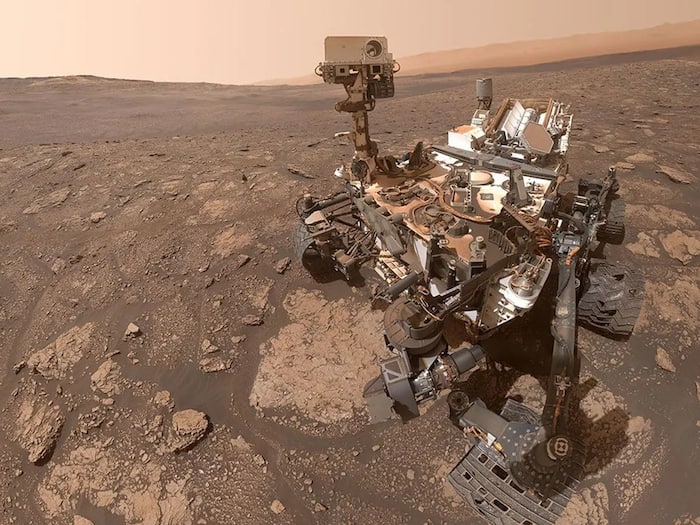
 NASA’s Curiosity rover has detected 21 organic molecules in a Mars rock sample.


Written By Shubham Arora
NASA has shared a new finding from Mars, and this one is getting attention for a different reason. The Curiosity rover has detected organic molecules that are usually linked to the building blocks of life. This doesn’t mean life has been found on Mars, but it does point to the planet once having the kind of chemistry needed for it.  Also Read: Meet NASA's Artemis III crew: The astronauts preparing for the next Moon mission
The NASA Curiosity rover landed on Mars in 2012, and the sample was collected back in 2020. Scientists have been studying it over the past few years. What they’ve found now adds to what we already knew about Mars not always being as dry and inactive as it looks today. Also Read: NASA astronauts may soon wear Prada on Moon missions
The rover picked up a rock sample that turned out to contain a mix of 21 organic molecules. Out of these, seven have been identified on Mars for the first time. Also Read: NASA's Hubble captures Galaxy M88 with a black hole 100 million times the Sun's mass
One of the key findings includes molecules that are similar in structure to compounds linked with DNA and RNA. These are considered important when it comes to how life forms and functions.
Along with that, compounds like benzothiophene were also found. These are usually seen in meteorites, which means there is a chance some of this material came from outside Mars.
The study was led by Amy Williams from the University of Florida, who is part of the Curiosity and Perseverance rover teams. The findings have been published in Nature Communications.
The sample came from near Mount Sharp in Gale Crater. Scientists think this area had water billions of years ago, most likely a lake.
After the water dried up, it left behind clay. These clay layers are useful because they can hold chemical traces for a long time, which is why this spot was studied.
The rock, named “Mary Anning 3,” was drilled by the rover and then analysed on Mars itself.
The Curiosity rover has a built-in lab called Sample Analysis at Mars, or SAM. This is what was used to study the sample.
The process involved heating the rock powder so that gases could be released and analysed. They used a chemical method with TMAH to break larger molecules into smaller ones.
That helped them pick up compounds that might have been missed otherwise.
The finding shows that Mars once had the basic chemistry needed for life. But that is where things stand for now.
At the same time, these molecules don’t always come from living organisms. They can form through natural processes or even reach Mars through meteorites. So this is still not proof that life existed there.

Scientists say clearer answers will only come when samples are brought back to Earth. The rover can analyse them, but only to a certain extent.

Don't Miss Out the Latest Updates. Subscribe to Our Newsletter Today!