
Written By Shubham Arora
Edited By: Shubham Arora | Published By: Shubham Arora | Published: Apr 29, 2026, 12:56 PM (IST)
 Social media platforms are becoming a major entry point for online scams.


Written By Shubham Arora
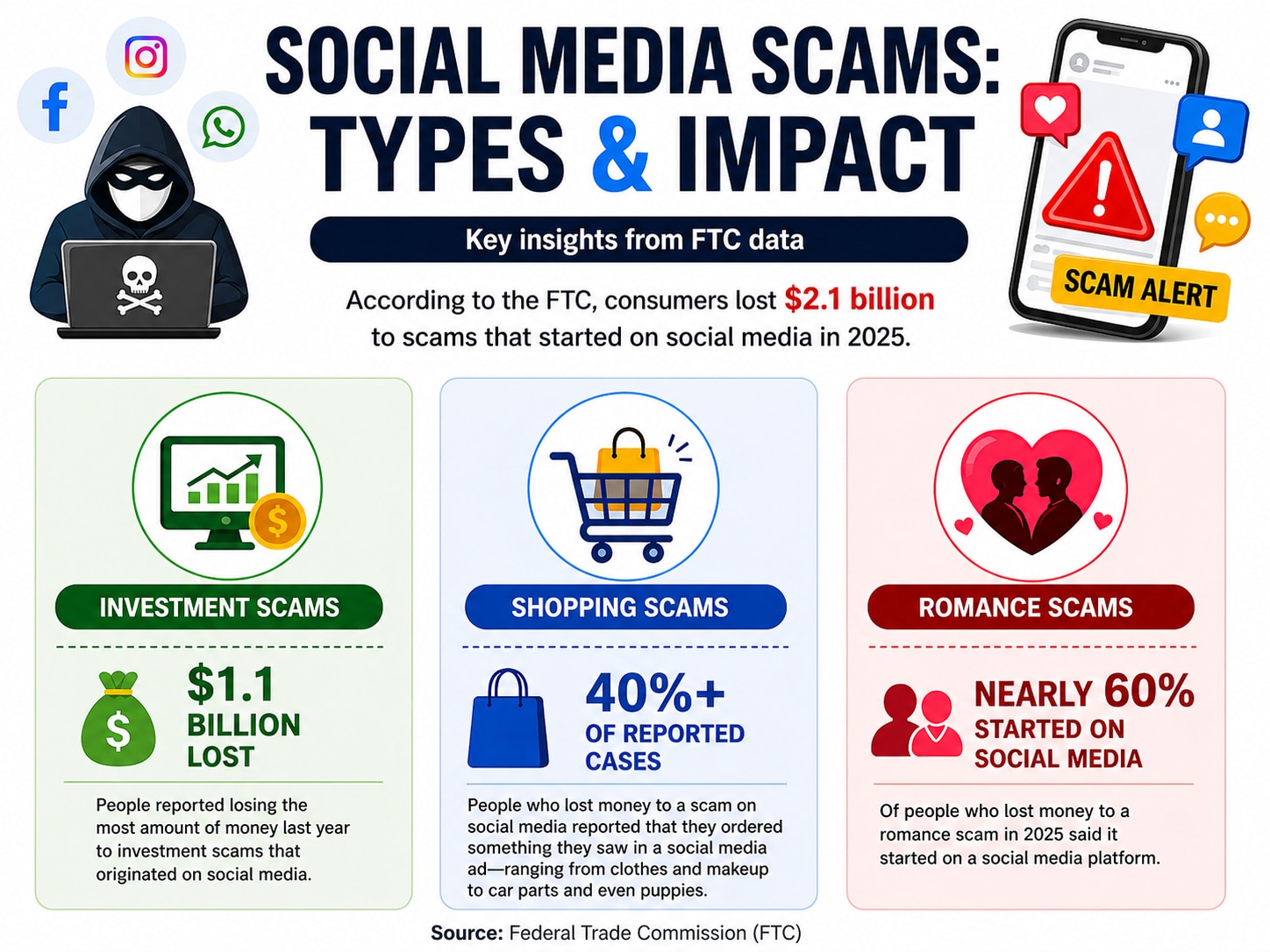
Social media is where most people spend a lot of time every day. It is also where a large number of scams are now starting. A recent report from the Federal Trade Commission shows that users lost around $2.1 billion to scams that began on social media platforms in 2025.  Also Read: WhatsApp Gets Two New Features To Tackle Scams; Get Alert From Unknown Groups
This is not just a one-off spike. The report also points out that these losses have grown sharply over the past few years and are now higher than scams that start through calls, texts, or emails. In simple terms, social media has become one of the main ways scammers reach people. Also Read: Top WhatsApp scams to stay away from, how to protect yourself
The report says that nearly 30% of people who lost money said the scam started on social media. Platforms like Facebook, Instagram, and WhatsApp show up frequently in these reports.
Among these, Facebook accounts for the highest share of losses. Users have reported losing more money through Facebook scams than through email or SMS-based scams.
Most of these scams don’t start in an obvious way. Sometimes it is an ad, sometimes a message, and sometimes even a known account that has been hacked. That makes it harder to spot early.
Shopping scams are the most common. People see an ad for a product at a low price, place an order, and either receive nothing or get something completely different. These ads often lead to websites that look normal at first glance.
Investment scams are where most of the money is lost. The report says about $1.1 billion went into such schemes. These usually begin with posts or messages about learning to invest or earning quick returns. Some scammers also create groups with fake success stories to make things look real.
Romance scams are also part of this. These usually begin with casual conversations and slowly turn into requests for money. In many cases, scammers use information from your profile to make their story sound convincing.
Social media gives scammers an easy way to reach people. They can create fake accounts, run ads, or even take over someone else’s profile and use that to reach people. At the same time, most of us share quite a bit about our daily lives online, which makes it easier for scammers to figure out who to target.

If someone already has an idea about your interests or routine, it becomes much easier for them to approach you in a way that doesn’t immediately raise doubts.

Don't Miss Out the Latest Updates. Subscribe to Our Newsletter Today!