
Written By Deepti Ratnam
Edited By: TECH Staff | Published By: TECH Staff | Published: Feb 02, 2026, 03:55 PM (IST)


Written By Deepti Ratnam
Indian businesses increasingly handle:
The DPDP Act, 2023 applies to organizations of all sizes. Regulators such as RBI, SEBI, IRDAI, and TRAI also impose sector-specific expectations on how sensitive data is managed.
For small teams, this creates three practical risks:
Cloud platforms like Google Workspace help reduce these risks by centralizing data, standardizing access controls, and making security settings predictable.
The DPDP Act focuses on five operational responsibilities:
The Act also allows the government to issue subordinate operational rules in the future. Businesses should prepare for these without relying on assumptions or fixed timelines.
While understanding the principles of the DPDP Act is essential, the real challenge for Indian SMBs lies in operationalizing them. The Act grants individuals (Data Principals) significant rights, most notably the Right to Correction and the Right to Erasure (Right to be Forgotten). In a traditional file server or paper-based setup, fulfilling these requests can take days of frantic searching. In Google Workspace, this becomes a structured, auditable process.
Handling a “Right to Erasure” Request: Imagine a former customer requests that their personal data be removed from your systems. Under the DPDP Act, you must comply unless retention is required by another law.
Step 1: Create a “Matter” in Vault specifically for the erasure request.
Step 2: Use search terms (like the customer’s email, Aadhaar number, or name) to locate every instance of their data across Gmail, Drive, and Chat.
Step 3: Review the results to separate “business-critical records” (e.g., invoices you must keep for tax purposes) from “personal data” (e.g., marketing lists or ID proofs) that can be deleted.
Step 4: Execute the deletion and export a report of the action. This report serves as your “proof of compliance” if regulators ever audit your response to the user’s request.
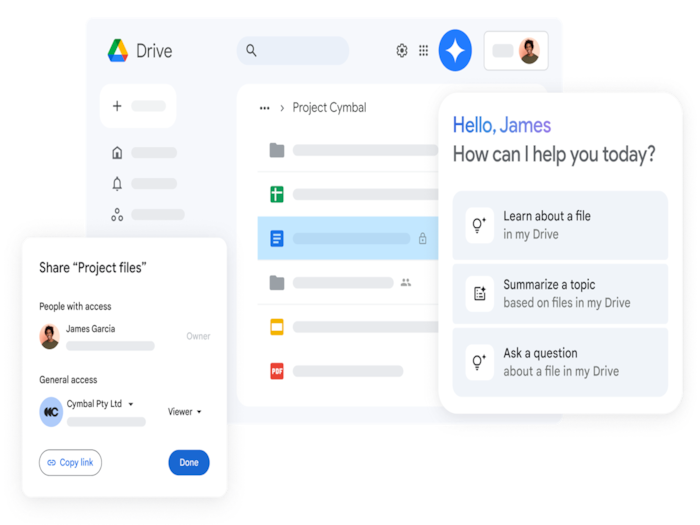
The Workspace Solution: With centralized directory management in the Admin Console, updating a contact’s details in the central global address list ensures the correct information propagates to all users. For documents, the AI-powered search in Drive allows you to quickly find legacy contracts containing old details and append the updated information, ensuring the “accuracy” principle of the DPDP Act is met without manual hunting.
Gemini operates inside the Google Workspace environment (Gmail, Drive, Docs, Sheets, Meet, Chat).
According to Google’s enterprise policy:
This design gives businesses:
For SMBs, this reduces uncertainty when introducing AI into daily operations.
AI classification uses Gemini to automatically:
Why this matters
This directly supports DPDP principles of data minimization and access restriction.
DLP monitors Gmail, Drive, and Chat for sensitive information and enforces rules such as:
Example: A file labeled “Customer Personal Data” can be blocked from being emailed outside the organization.
DLP significantly reduces accidental data leaks during routine work.
IRM prevents sensitive files from being downloaded, copied or printed. This is useful for:
IRM demonstrates that technical safeguards are in place, not just written policies.
Admins can review file access, sharing events, permission changes, login activity. These logs support incident investigation, internal audits, and regulatory responses.
Workspace admins can:
This enables businesses to honour deletion requests under the DPDP Act without building custom systems.
IT administrators can:
This allows controlled, low-risk AI adoption.
Google Workspace gives your business IT administrator the option to pick the specific physical location where your primary files and emails are saved on a server. Currently, there are only two options to choose from — the United States or the European Union. This is done to help businesses meet certain legal or contract-specific requirements.
This is disclosed transparently so organizations can plan accordingly. Workspace data for Indian customers is typically distributed globally unless a US or EU specific policy is applied.
Not all compliance features are available in every plan. Compare plans and pricing.
| Feature | Business Starter | Business Standard | Business Plus | Enterprise |
| AI classification (Drive) | ❌ | ❌ | ❌ | ✅ |
| DLP | ❌ | ❌ | ✅ (basic) | ✅ (advanced) |
| Information Rights Management (IRM) | ✅ | ✅ | ✅ | ✅ |
| Advanced audit logs | ❌ | ❌ | ✅ | ✅ |
| Data region controls | ❌ | ✅ | ✅ | ✅ |
| Gemini admin controls by OU | Limited | Limited | Limited | Full |
Businesses in regulated industries or handling sensitive customer data should typically evaluate Enterprise plans for full governance coverage.
Google Workspace and Google Cloud hold widely recognized certifications, including:
These certifications do not replace DPDP compliance but simplify vendor risk assessments and client audits.
A financial services consultant collects client PAN cards and Aadhaar copies via WhatsApp or personal Gmail. These sensitive files are downloaded to a local laptop folder named “New Clients.” If that laptop is lost or the employee leaves, that data is compromised, violating the DPDP obligation for “reasonable security safeguards.”
The Workspace Implementation:
The CFO emails the quarterly financial projections (an Excel sheet) to five board members. Two members download it to their iPads; one forwards it to their personal email to print at home. You have now lost control of highly sensitive financial data.
The Workspace Implementation:
While only the DPDP Act, 2023 is currently enforceable, future operational rules are expected to provide more details around:
Google Workspace already provides these capabilities, allowing businesses to prepare without re-architecting systems later.
Legal review is still required, but drafting time is reduced.
One of the most underutilized capabilities of Gemini is its role as a “junior compliance analyst.” For small teams that cannot afford a dedicated legal department, Gemini can drastically reduce the administrative burden of privacy documentation.
Here are two specific prompt structures an IT or Compliance lead can use:
Context: You have a 40-page technical document describing your data flows, and you need a simple summary for your website.
Prompt: “I am uploading our internal data security architecture document. Please act as a Data Privacy Officer. Based on this document, draft a clear, 300-word ‘Data Safety’ section for our public website. Focus on explaining how we encrypt customer data and our policy on not selling data to third parties. Use reassuring, plain English suitable for an Indian consumer audience.”
Context: You have a folder of mixed old contracts and need to know which ones contain sensitive financial terms.
Prompt: “Analyze the attached 10 vendor contracts. Identify which of these contracts contain ‘penalty clauses’ or ‘financial liability’ exceeding ₹5 Lakhs. List the file names and the specific page numbers where these terms appear. Do not summarize the whole document; just highlight the financial risk areas.”
It should be noted that while Gemini is powerful, it is always necessary to have a human review legal outputs for final accuracy.
The DPDP Act, 2023 makes data protection a business responsibility for organizations of every size.
Google Workspace provides the technical foundation to meet these obligations. Gemini adds productivity without breaking security boundaries when deployed correctly.
For Indian solopreneurs and SMBs, this combination allows:

When configured properly, Google Workspace becomes not just a productivity platform, but a practical compliance partner for modern Indian businesses.

Don't Miss Out the Latest Updates. Subscribe to Our Newsletter Today!