
Written By Shubham Arora
Published By: Shubham Arora | Published: Feb 11, 2026, 06:24 PM (IST)


Written By Shubham Arora
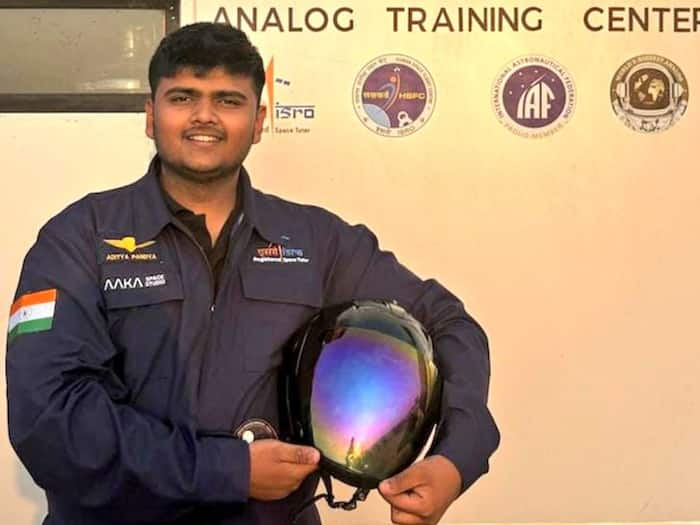
India’s recent space missions have led to more students showing interest in space research and engineering. Among them is 17-year-old Aditya Pandya, who recently completed an eight-day lunar simulation mission in Gujarat. With this, he has been recognised as one of India’s youngest male analog astronauts.  Also Read: PSLV-C62 Mission: ISRO To Launch EOS-N1 And 15 Co-Passengers This Week, Check Date, Mission Details, More
The mission took place from February 1 to 8 in Dholavira, located in Gujarat’s Kutch region. It was organised by AAKA Space Studio, which works on planetary analog research and is registered as an ISRO Space Tutor. Also Read: ISRO's LVM3 Successfully Launches US BlueBird Block-2 Satellite into Orbit: ALL Details
Aditya, along with three other crew members, lived inside a container-style habitat designed to simulate Moon-like conditions. For eight days, the crew stayed inside the habitat without direct contact with the outside world. Communication was restricted, and controlled systems were used to operate everything inside the structure. Air supply, monitoring, and daily routines were managed through the equipment installed in the habitat. The team followed a fixed schedule, similar to what astronauts follow during space missions. Also Read: Gaganyaan Mission Update: ISRO Plans Half-Humanoid Vyommitra Launch Before Astronauts
The purpose of the simulation was to observe how people handle isolation, confined spaces, and limited resources over an extended period. Missions like these are designed to study human behaviour and system reliability in conditions that resemble long-duration space travel.
Aditya was not only part of the crew living inside the habitat. He was also involved in developing several systems used during the mission.
Prior to the simulation, he worked for months to build air-quality sensors, biometric tracking devices, and fault-detection hardware. These systems were used to monitor oxygen levels, crew health metrics, and the overall performance of the habitat. He also used 3D printing to design and test components before they were deployed inside the simulation setup.
As reported by ANI, the systems he helped develop performed as intended during the eight-day simulation.
As per his LinkedIn profile, Aditya completed his schooling at Asia English School, where he studied Science, Mathematics, and Artificial Intelligence. He later pursued certifications in Generative AI and completed a related course from the Massachusetts Institute of Technology. He is currently studying Computer Engineering at the Institute of Advanced Research in Gandhinagar.
AAKA Space Studio has said that the mission aimed to strengthen India’s analog research ecosystem by combining engineering, simulation science, and astronaut-style training. For Aditya, the experience was not just about living inside a simulation, but about testing the very systems he helped create.

At 17, he has already experienced a version of life designed to prepare humans for future lunar missions.

Don't Miss Out the Latest Updates. Subscribe to Our Newsletter Today!