Written By Divya
Published By: Divya | Published: Feb 12, 2026, 03:50 PM (IST)


Written By Divya
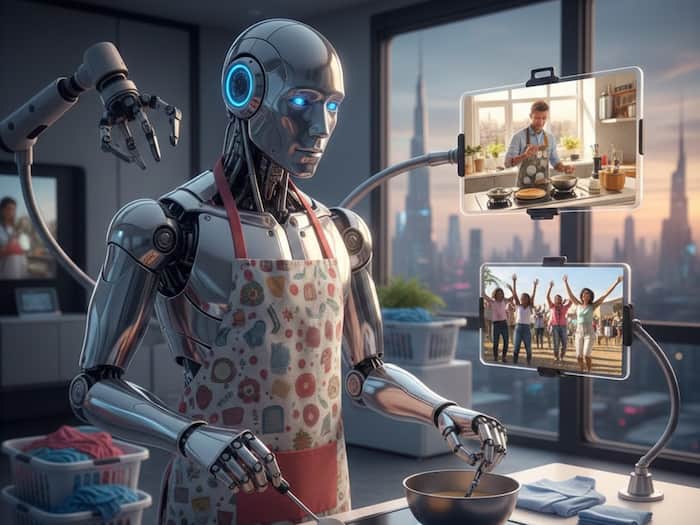
We may have seen robots learning themselves via videos in sci-fi movies so far, however, it seems that it is slowly turning into reality. We say so because NVIDIA has introduced a new artificial intelligence system called DreamDojo, which is simply helping robots understand the physical world, just by observing how humans interact with it.  Also Read: NVIDIA GeForce NOW finally coming to India after years of wait: What gamers should know
The research, developed with institutions including UC Berkeley, Stanford, and the University of Texas, tries to address one of robotics’ biggest hurdles: teaching machines to operate smoothly in unpredictable, real-world environments. Also Read: Weirdest Tech of CES 2026: AI Hair Clippers, AI Companions, and Robots With Human-Like Emotions
At its core, DreamDojo is described as a “robot world model.” Instead of depending only on demonstrations performed by robots, the system learns from a massive library of nearly 44,000 hours of human-centric video. Also Read: Best Tech of CES 2026: Samsung Galaxy Z TriFold, Lenovo’s Rollable Laptops, Asus ROG XREAL R1 and the Future of Innovation
This dataset, called DreamDojo-HV, is far larger than earlier training collections and spans thousands of scenes along with a wide set of skills. The thinking behind it is fairly straightforward – before a robot touches or moves an object, it should first understand how humans handle it.
DreamDojo follows a two-step learning approach. To begin with, the AI studies human behaviour to develop a foundational understanding of physics and object interaction. After that, the knowledge is fine-tuned for specific robot hardware so the machine can convert what it has observed into real actions.
Researchers say the system can simulate interactions in real time at roughly 10 frames per second, allowing robots to anticipate outcomes before making a move. Simply put, the robot gets the ability to “think ahead” rather than rely purely on trial and error.
This could prove important because training robots has traditionally been both expensive and time-consuming, often requiring detailed demonstrations for every single task. By learning from existing human videos, DreamDojo can reduce both development time and cost.

Another advantage is simulation. Companies can evaluate how a robot behaves in a virtual setting before sending it into the real world – lowering risks and improving reliability. It is still early days for the technology, but the direction is clear. AI may not remain confined to screens for long. Instead, it could increasingly step into the physical world – one trained robot at a time.

Don't Miss Out the Latest Updates. Subscribe to Our Newsletter Today!