
Written By Shubham Arora
Published By: Shubham Arora | Published: Apr 30, 2026, 07:59 PM (IST)
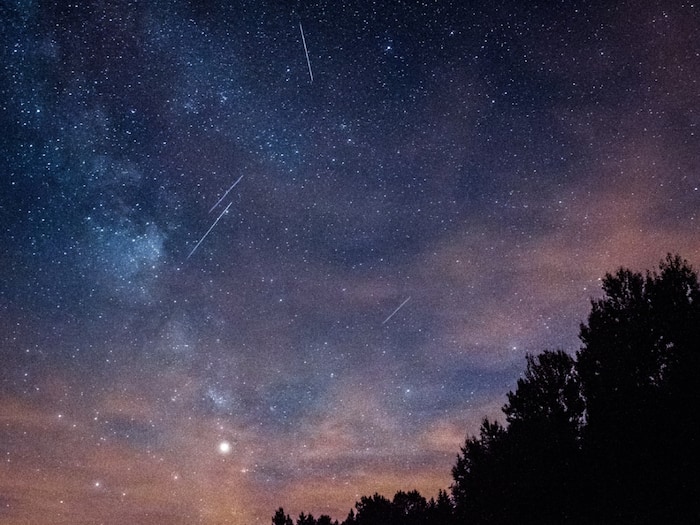
 Meteor shower and other celestial events will be visible in the night sky in May.


Written By Shubham Arora
May 2026 will be a packed month for anyone who likes looking up at the night sky. There are multiple events lined up, from meteor showers and full moons to close alignments between the Moon and planets. The good part is that many of these can be seen without any special equipment, as long as the sky is clear.  Also Read: Blue Origin’s New Glenn rocket explodes in fireball during pre-launch test
Most of the events are spread across the month, which means you don’t have to wait for just one night. Whether you are watching from a city or a darker location, there will be something visible at different times. Some events are better seen early in the morning, while others are easier to catch after sunset. Also Read: Rare Meteor Shower Or Satellite Debris? Delhi-Noida Sky Lights Up Overnight
The month begins with a full moon on May 1, often referred to as the Flower Moon. It reaches peak illumination during the day, but the best time to watch it is in the evening when it rises. Since it occurs near the Moon’s farthest point from Earth, it appears slightly smaller than usual, which is why it is also called a micromoon.
Later in the month, on May 31, there will be another full moon. This is what is known as a Blue Moon, meaning it is the second full moon in the same calendar month. This one is also a micromoon, making it a relatively rare combination.
One of the key highlights of May is the Eta Aquariid meteor shower, which peaks between May 5 and May 6. These meteors come from debris left behind by Halley’s Comet.
Under dark skies, it is possible to see several meteors per hour, especially in the early morning. The best time to watch is between 3:00 AM and 6:00 AM, just before sunrise. The Southern Hemisphere usually gets a better view, but it is still visible from many parts of the world.
Mid-May brings a series of close alignments between the Moon and visible planets. Between May 13 and May 14, the Moon appears close to Saturn, Neptune, and Mars in the evening sky. This creates a cluster that can be spotted with the naked eye, although Neptune may need binoculars.
On May 19, the Moon will appear close to Venus after sunset. This is one of the easier events to spot, as Venus is one of the brightest objects in the sky.
A day later, on May 20, the Moon will be seen near Jupiter. This pairing is also clearly visible without any equipment and can be observed in the evening hours.
On May 21, the Moon passes near the Beehive Cluster, a group of stars located in the constellation Cancer. The cluster itself may look like a faint patch in the sky, but it becomes clearer if you use binoculars.
From May 23 to May 27, the Moon moves close to two bright stars, Regulus and Spica. These alignments happen over multiple nights, so you can catch them on more than one day depending on weather conditions.

Around May 16, there is a new moon, which means the sky will be darker than usual. This is one of the better times to try spotting the Milky Way, especially if you are away from city lights. The Milky Way core becomes visible late at night and continues into the early morning. Clear skies and low light pollution make a noticeable difference for this.
| Event | Date | Best Time (EDT) | Where to Watch |
|---|---|---|---|
| Full Moon (Flower Micromoon) | May 1 | Evening (after moonrise) | Visible across India and worldwide; open sky view works best |
| Eta Aquariid Meteor Shower Peak | May 5-6 | 3:00 AM – 6:00 AM | Better visibility in Southern Hemisphere but visible in India |
| Moon near Saturn, Neptune & Mars | May 13-14 | 8:00 PM – 11:30 PM | Visible from most parts of the world |
| New Moon (Milky Way viewing) | Around May 16 | Late night to early morning | Visible worldwide |
| Moon near Venus | May 19 | After sunset (8:00 PM – 11:00 PM) | Visible worldwide |
| Moon near Jupiter | May 20 | 8:30 PM – 11:30 PM | Visible worldwide |
| Beehive Cluster close approach | May 21 | 9:00 PM – 12:00 AM | Visible worldwide; darker locations preferred |
| Moon near Regulus and Spica | May 23-27 | 10:00 PM – 2:00 AM | Visible worldwide |
| Blue Micromoon (Full Moon) | May 31 | 4:45 AM (peak) | Visible worldwide; best after moonrise |

Don't Miss Out the Latest Updates. Subscribe to Our Newsletter Today!