Written By Divya
Published By: Divya | Published: Aug 16, 2025, 06:50 PM (IST)


Written By Divya
 Also Read: Annular Solar Eclipse 2026: Timing, countries that can see Ring of Fire, and more
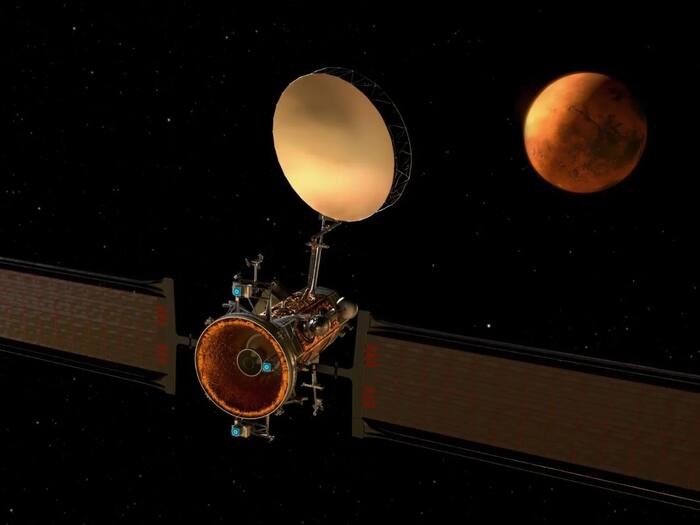
Mars has always been a focus for space exploration. Both rovers and orbiters have collected and transmitted data of great value. However, as missions escalate in complexity, for example, to bring samples back to Earth or to send astronauts to Mars, one challenge appears to be bigger than the rest — reliable communication. To address this issue, Blue Origin has proposed a new spacecraft Mars Telecommunications Orbiter (MTO), proposed to act as a Mars and Earth communication relay satellite. Also Read: Meet Athena: NASA’s new supercomputer is its most powerful yet
Once approved, the orbiter is expected to be launched in 2028, aiding robotic missions and future human explorers in staying connected. At present, most data from Mars travels through NASA’s ageing orbiters, such as the Mars Reconnaissance Orbiter (MRO) and MAVEN, along with ESA’s Trace Gas Orbiter. But these spacecraft won’t last forever. When they are retired, Mars missions could face major communication challenges. Also Read: ExoMiner++: NASA turns to AI to speed up the search for Earth-like exoplanets
The MTO would use multiple steerable high-rate links and a wide-area beam for continuous coverage. To support older Mars hardware and new landings, it could also deploy small ultrahigh frequency (UHF) relay satellites in low Mars orbit.
The spacecraft will be based on Blue Origin’s Blue Ring modular satellite bus, a platform equipped with onboard processing, storage, and AI capabilities. The system can carry over 1,000 kg of payloads, making it adaptable to different mission needs.
One of MTO’s key features is its hybrid propulsion system, which combines chemical and electric thrusters. This gives the spacecraft more manoeuvrability and extends mission life. It also widens the launch windows for reaching Mars, something that purely chemical systems cannot achieve.
NASA’s plans for a Mars Sample Return mission and eventually crewed exploration require a dependable communication backbone. Blue Origin says MTO could help fill that role, ensuring higher bandwidth and more reliable data transfer.
For now, the orbiter is only a concept. NASA has not awarded a contract, and the idea remains within Blue Origin’s broader portfolio of planetary mission spacecraft. Still, with major Mars launches planned for 2026 and 2028, the company is positioning MTO as a timely option.


Don't Miss Out the Latest Updates. Subscribe to Our Newsletter Today!