
Written By Deepti Ratnam
Published By: Deepti Ratnam | Published: Jan 21, 2026, 01:03 PM (IST)


Written By Deepti Ratnam
The human brain is one of the most challenging parts of our body and it has always remains greatest scientific challenge of our time. However, if someone says he o she has developed how billions of neurons connect and communicate, then the person must have found a way to map the human brain. Mapping the human brain could unlock answers about memory, behavior, and most importantly, diseases. Traditionally, mapping the human brain in detail has been slow, costly, and limited to a handful of top-notch laboratories. Nevertheless, an Indian-origin Harvard professor, Aravinthan Samuel, is helping change that with his innovative technology. Samuel’s technology makes brain scanning faster and more accessible.
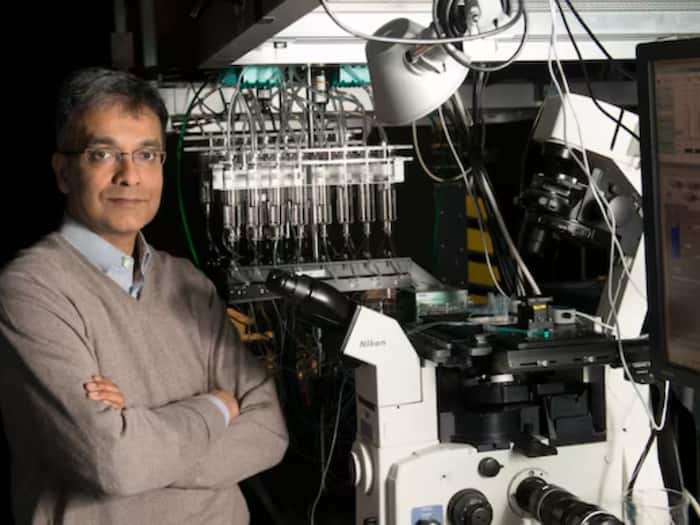
Aravinthan Samuel is a Harvard professor, who built his career in physics, biophysics, and neuroscience. He is a triple Harvard alumnus with a degree in BA in Physics and PhD in Biophysics. In addition, he has also earned postdoctoral training in neuroscience. His research focuses on how biological systems process information.
Samuel’s researches mainly focus on topics like computation and brain science with an aim to make complex experiments more practical at scale. Over the years, he earned top awards from reputed organizations, including the NSF CAREER Award, the Presidential Early Career Award for Scientists and Engineers, and the NIH Director’s Pioneer Award.
Samuel has developed a machine learning guided system called SmartEM, which is designed to improve electron microscopy. From what we know in our research, the electron microscopes scan brain tissues in a slow and uniform manner. They produce enormous amounts of data. The new SmartEM technology by Samuel will provide a quick overview scan to identify areas likely to contain important structures. After this, it will focus on sections in high detail. This approach by SmartEM technology saves time, reduces costs, and maintains the precision that’s required for serious neuroscience research.
A large network of neurons is responsible for our brain functioning, and hence, it controls our thoughts, emotions, and action. Scientists worldwide aims to mp these network to understand how brain works, how information flows, and how disease disrupt connectivity. They also want to understand how brains of different species are organised. The SmartEM technology is faster and cheaper and it will accelerate the research into memory, especially for patients suffering from Alzheimer, Autism, and Parkinson.

One of the biggest benefits of SmartEM technology is its being less expensive and giving rare equipments. Smaller labs and universities will be able to contribute to high-level research with the help of SmartEM, helping more scientists ask bigger questions and make discoveries at an unprecedented pace.

Don't Miss Out the Latest Updates. Subscribe to Our Newsletter Today!