Written By Divya
Published By: Divya | Published: Apr 04, 2026, 10:00 PM (IST)
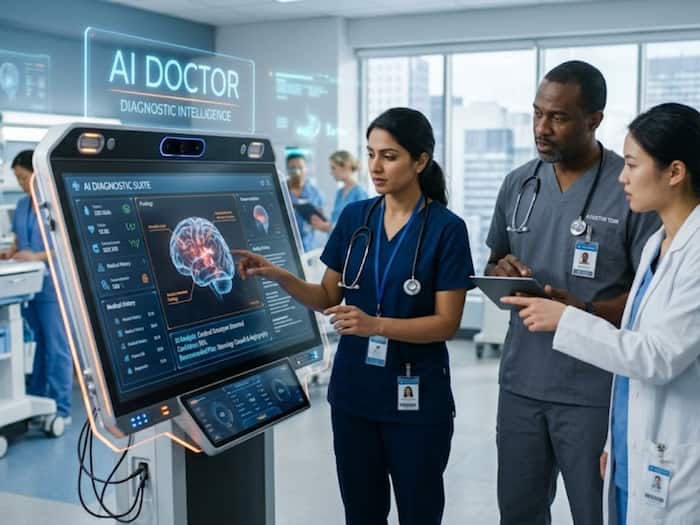
 How Artificial Intelligence is Rewriting Early Disease Detection


Written By Divya
It normally begins with some small symptoms – a headache, a cough, or maybe a random pain. You Google it and now maybe even ask an AI chatbot, and suddenly you have a list of possible diagnoses. But the real question is – can AI move beyond just suggesting and actually help you detect diseases before even the symptoms appear?  Also Read: Is Perplexity Incognito Mode really private? Lawsuit says otherwise
Well, things have already headed in that direction. Now, hospitals, research labs, and even tech companies are adapting to AI in detection, diagnosis and even prevention. Slowly, but it is progress. But there are several questions on all of our minds. Also Read: Meta layoffs continue in 2026, around 200 jobs cut in California
So far, healthcare has been a series of events – you feel sick, you go to the doctor, and then treatment begins. However, AI is changing the story. A report by Roche highlights how healthcare systems are now moving toward early detection and preventative care, especially for chronic conditions like cancer, diabetes, and heart disease. These are some illnesses which are easier to avoid if they are caught early. Also Read: Microsoft expands AI beyond text with new image, voice and transcription models
How AI helps here is that it can process a large amount of patient data and identify some common patterns that humans might even miss. As Dr. Okan Ekinci noted in the Roche report, the goal is to use “multidimensional data” to match the right treatment to the right patient. In simple terms, instead of waiting for the disease to show up, AI is helping doctors predict it.
This is where things start to feel almost futuristic. According to a World Economic Forum report, AI models are already being trained on massive datasets to detect early signs of more than 1,000 diseases — sometimes years before symptoms begin. These include conditions like Alzheimer’s, kidney disease, and lung disorders.
The idea is simple: your body leaves behind tiny signals long before you feel unwell. AI can pick up those signals. In cancer research, this becomes even more powerful. A Cancer Research Institute blog explains how AI models have been able to predict pancreatic cancer risk by analysing patterns in patient records, even when those patterns didn’t seem directly related to the disease. That’s something traditional screening would struggle to do.
AI isn’t just working in the background; it’s already assisting doctors in real clinical settings. Take medical imaging. AI tools are now being used to:
The World Economic Forum notes that in some cases, AI systems have even outperformed human experts in interpreting scans, especially when it comes to speed and pattern recognition. A real-world example comes from Google’s research on breast cancer detection. In collaboration with the NHS and Imperial College London, their AI system was able to detect 25% of cancers that were previously missed during screening.
What’s more interesting is how it fits into existing workflows. When used as a “second reader” alongside doctors, the system reduced screening workload by up to 40%, giving specialists more time to focus on complex cases. So it’s not replacing doctors, it’s changing how they work.
AI is even in hospitals too, at least some! In cases like sepsis, a life-threatening condition that’s hard to detect early, AI models are being used to analyse patient data in real time and flag high-risk cases. The Roche report highlights how predictive algorithms can help identify which patients need urgent care and which ones can be managed differently. Similarly, machine learning models are being used in primary care to predict hospital admissions, identify high-risk patients, and optimise resource allocation.
One study mentioned in the Roche discussion showed that AI was better than clinicians alone at predicting which patients were likely to require hospitalisation.
This is still debatable! A Forbes report talks about a startup called Certuma that wants to build the first FDA-approved AI doctor. The idea is to create an AI system that can diagnose and treat common conditions like sore throats or urinary infections without needing a human doctor for every case.
The logic is basic – there aren’t enough doctors for everyone. In such cases, AI could act as a first layer of care, available anytime, anywhere. But even the people building these systems admit that we’re not fully there yet. AI still makes mistakes, and in healthcare, even a small error can have serious consequences. That’s why most current approaches focus on human + AI collaboration, rather than full automation.
The trust issues with AI are still there. While AI can improve accuracy, it can also create new risks. A recent report by TIME found that doctors who regularly used AI tools became less skilled at detecting cancer when the AI wasn’t available. Researchers described this as a kind of dependency. One expert compared it to relying on Google Maps, once you get used to it, navigating on your own becomes harder.
This raises an important question – if AI becomes a constant support system, do humans start switching off? Some experts argue that this is not a problem with AI itself, but with how we use it. The challenge is to ensure that AI supports decision-making without replacing human judgment.
Plus, there are also concerns around privacy and bias. Healthcare data is sensitive, and any misuse could have serious implications. As mentioned in multiple reports, including the World Economic Forum and CRI discussions, responsible use of AI will be just as important as innovation itself.

Surely, AI in healthcare is no longer just an idea, it’s already here. At least for now, it’s about building systems where AI handles large-scale data and pattern recognition, and humans handle judgment, empathy, and complex decisions. The idea of a fully autonomous AI doctor might still be some distance away. But a future where AI quietly helps catch diseases before you even feel them? That’s already beginning.

Don't Miss Out the Latest Updates. Subscribe to Our Newsletter Today!