How long is a day on other planets? The answers are surprising
From fast-spinning Jupiter to slow-moving Venus, here’s how the length of a day changes across planets.
Published By: Shubham Arora
Published: Apr 25, 2026, 10:54 PM (IST)
When we talk about a "day," we usually mean the time from one sunrise to the next. On Earth, that works out to roughly 24 hours, so it feels normal. But that's only because we're used to how Earth moves. If you step outside our planet and look at the rest of the solar system, the idea of a day starts to change quite a bit.
In simple terms, a day is the time a planet takes to complete one full rotation on its axis. Scientists often compare everything to Earth's timing to keep things easy to understand. Once you do that, you realise that not all days are created equal. Some planets spin very fast, while others take so long that a single day can last longer than a year there.
What "a day" actually means
There are two ways to look at a day. One is the regular day we experience, from sunrise to sunrise. The other is the time a planet takes to spin once on its axis. For Earth, that rotation takes about 23 hours and 56 minutes, which is slightly less than the 24-hour cycle we follow.
This difference is small for us, but it becomes easier to notice once you look at other planets. Each one spins at its own pace, and that directly decides how long a day lasts there.
The fastest and slowest days
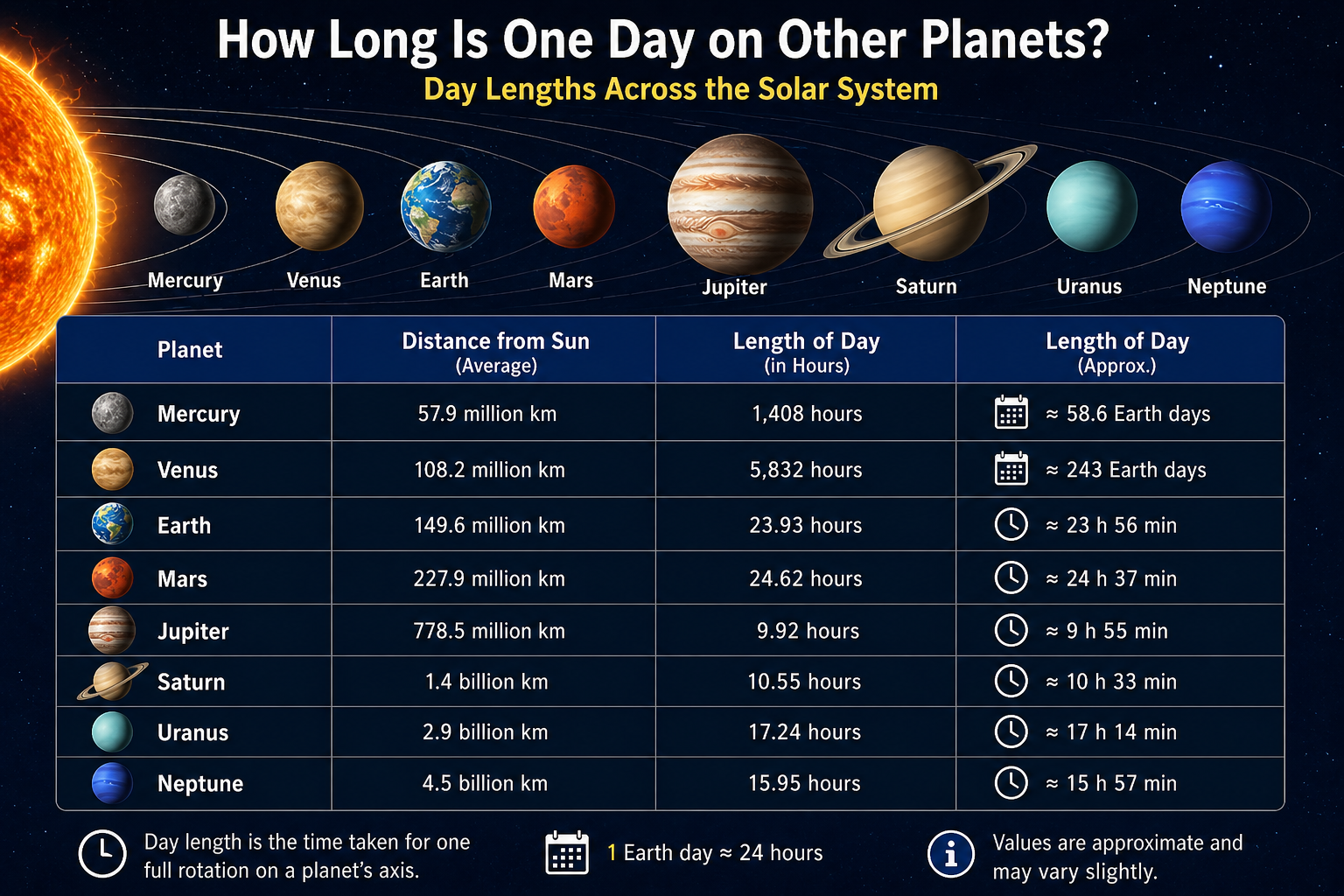
Some planets complete a full rotation surprisingly quickly. Jupiter, for example, takes just under 10 hours to spin once. Saturn is close as well, finishing a day in a little over 10 hours. Even Neptune and Uranus rotate relatively fast, with days lasting around 16 to 17 hours.
On the other side, things get much slower. Mercury takes about 58 Earth days to complete one rotation. That's already long, but Venus goes even further. A single day on Venus lasts around 243 Earth days, which is actually longer than its year.
| Planet | Length of Day |
| Jupiter | 9 hours 55 minutes |
| Saturn | 10 hours 33 minutes |
| Neptune | 15 hours 57 minutes |
| Uranus | 17 hours 14 minutes |
| Earth | 23 hours 56 minutes |
| Mars | 24 hours 37 minutes |
| Mercury | 58.6 Earth days |
| Venus | 243 Earth days |
Why some planets take so long
The rotation speed of a planet depends on how it formed and how it has interacted with other objects over time. Take Mercury, for example. It has a slightly unusual relationship with the Sun, which slows things down. Because of this, a single day there stretches across several Earth weeks.
Venus is even stranger. It spins very slowly, and in the opposite direction. So the Sun wouldn't rise in the east like it does here, it would come up from the west and set in the east.
Planets that feel more familiar
Not every planet is this extreme. Mars is actually quite close to Earth in terms of day length. A day there lasts about 24 hours and 37 minutes, which is why it often comes up in discussions around future missions.
Why scientists track this
The length of a day isn't just a number. It affects how hot or cold a planet gets, how its weather behaves, and how missions are planned. Timing things on another planet works very differently when a day is not close to 24 hours.
Get latest Tech and Auto news from Techlusive on our WhatsApp Channel, Facebook, X (Twitter), Instagram and YouTube.