After Delhi fire incident, I went back to one question - can AC blasts be a real risk?
We recently spoke about AC risks, and now the Delhi fire incident has raised similar concerns. While some claim an AC blast, authorities say the cause is still under investigation. But here are some precautions that you must keep in check.
Published By: Divya | Published: May 03, 2026, 03:51 PM (IST) | Edited: May 03, 2026, 05:28 PM (IST)
We just talked about AC blast possibilities a few days back that how rising heat, poor maintenance, and electrical issues can sometimes turn air conditioners risky. And now, after the recent fire incident in Delhi's Vivek Vihar, a similar question is coming up again. Was an AC blast one of the possible reasons behind the fire?
Right now, there is no official confirmation. But there are some early claims and observations worth understanding. And this is something which we all should not avoid in this scorching summer.
Why ACs explode in summer: Warning signs and how to prevent fires
Delhi's Vivek Vihar Fire Case: What happened
As per the report by ANI, a fire broke out in a four-storey residential building in Vivek Vihar in the early hours of the morning. Most people were asleep, which made the situation worse. According to reports, the fire spread quickly across multiple floors. Several families were affected, and rescue operations were carried out with the help of multiple fire tenders. Some residents were rescued using ladders, while others, especially those in the rear flats, could not get out in time.
Authorities are still investigating what exactly caused the fire.
AC blast or short circuit?
This is where things get unclear. Speaking to ANI, a local resident claimed that the fire may have started after an AC blast. According to the statement, there was a loud explosion before the fire spread. At the same time, other locals and officials have suggested that a short circuit could also be a possible reason. Even local representatives have said that the exact cause is still not confirmed. So for now, both possibilities are there, but nothing has been officially verified yet.
Why are AC blasts a serious concern?
However, the mention of an AC blast is not coming out of the blue. As we discussed earlier, during peak summer, air conditioners run for long hours, often without breaks. This increases the stress on internal components like compressors and wiring.
If there is poor maintenance, gas leakage, overheating or electrical fluctuation, the risk of malfunction increases. In rare cases, this can lead to fire or even explosion-like situations. That said, such incidents are not very common, but when they happen, the impact can be serious.
Moreover, what is concerning is how fast the fire spread. In the Delhi fire incident, many residents were asleep, and by the time people realised what was happening, the situation had already worsened. Some residents also pointed out that not everyone in the building was alerted in time.
AC Blast: What should you keep in mind?
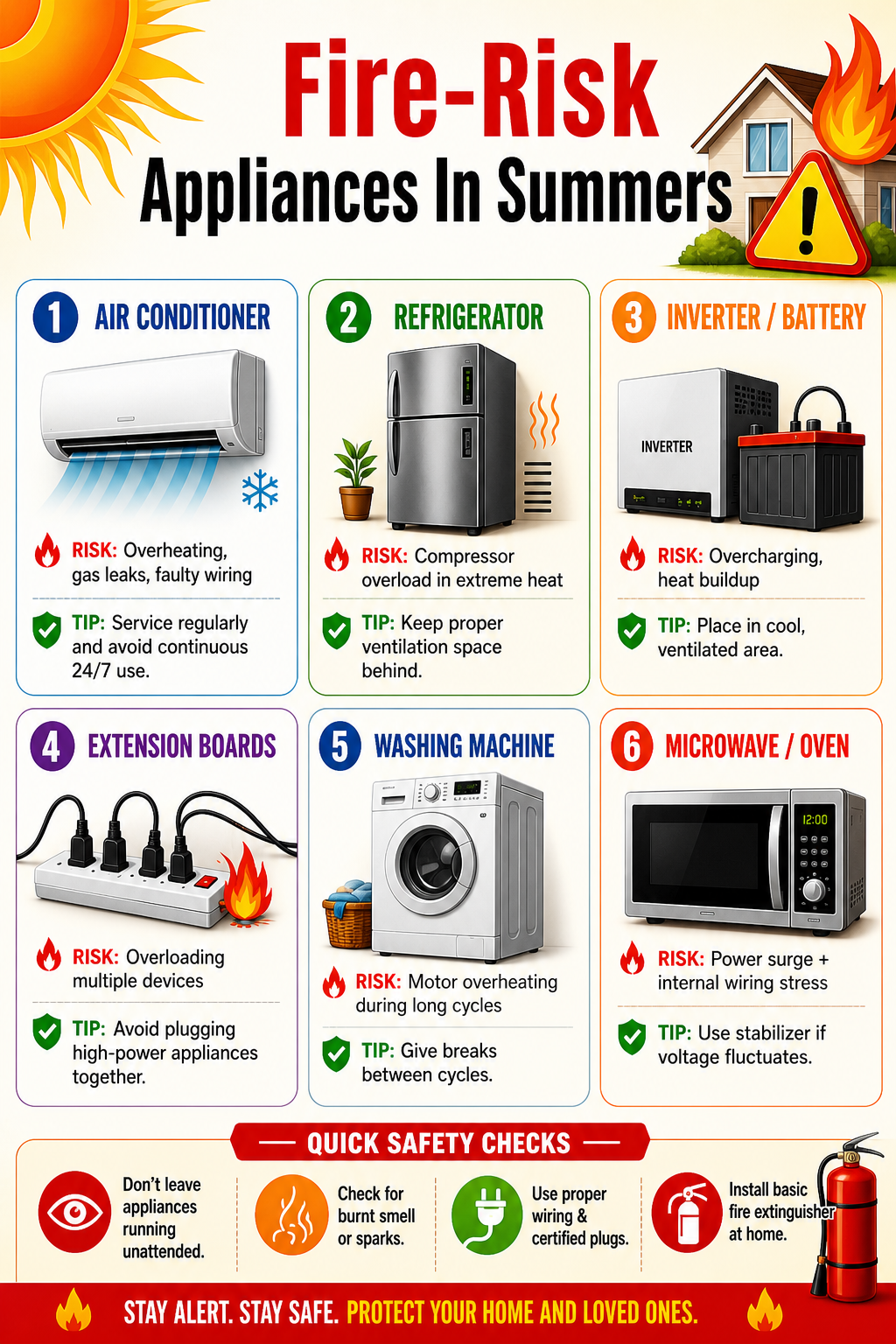
It will be too early to confirm that the AC blast is the reason behind the Delhi fire incident. However, it surely reminds us to be aware and cautious about our AC conditions, because that's something we are all actively using in our daily lives these days. It is not just about AC, but other everyday appliances too, such as refrigerators, chargers, inverters, and inverter batteries, which can be risky if not maintained properly.
Here are some simple checks that I always keep in check at home and you should actively follow these in the summer too:
Get latest Tech and Auto news from Techlusive on our WhatsApp Channel, Facebook, X (Twitter), Instagram and YouTube.