Is using 10 minutes of AI making your brain lazy? This study proves it
AI may not be helping you; instead, making you lazy! A new study suggests that relying on AI for just 10 minutes may reduce persistence and independent thinking. Here is all you must know now.
Published By: Divya
Published: May 08, 2026, 02:53 PM (IST)
We all netizens, are guilty of using AI in one way or another. We may argue that we are just getting a little help from AI bots such as ChatGPT, Gemini, Claude, or even Grok, but it can lead to a whole day's habit. From writing emails, planning our schedules, and making images to even summarising files and articles - we have slowly made AI tools a part of our daily lives.
But a new study by researchers from Carnegie Mellon University, Massachusetts Institute of Technology, Oxford, and UCLA suggests that even a short duration of AI use can affect how you think independently. Short duration here means even 10 minutes of usage, which can reduce persistence and independent reasoning once the AI support disappears.
Is AI making you lazy? Read the study
The research involved more than 1,200 participants (1,222 to be precise) across three different experiments, where people were divided into groups and asked to solve maths and reading comprehension tasks.
According to the study, one group worked entirely on their own. The other group received help from an AI assistant powered by advanced language models. So, initially, the AI-assisted participants looked faster and more accurate. They solved more problems correctly and completed tasks more quickly during the assisted phase. But things changed the moment the AI support was suddenly removed.
What happened when AI disappeared?
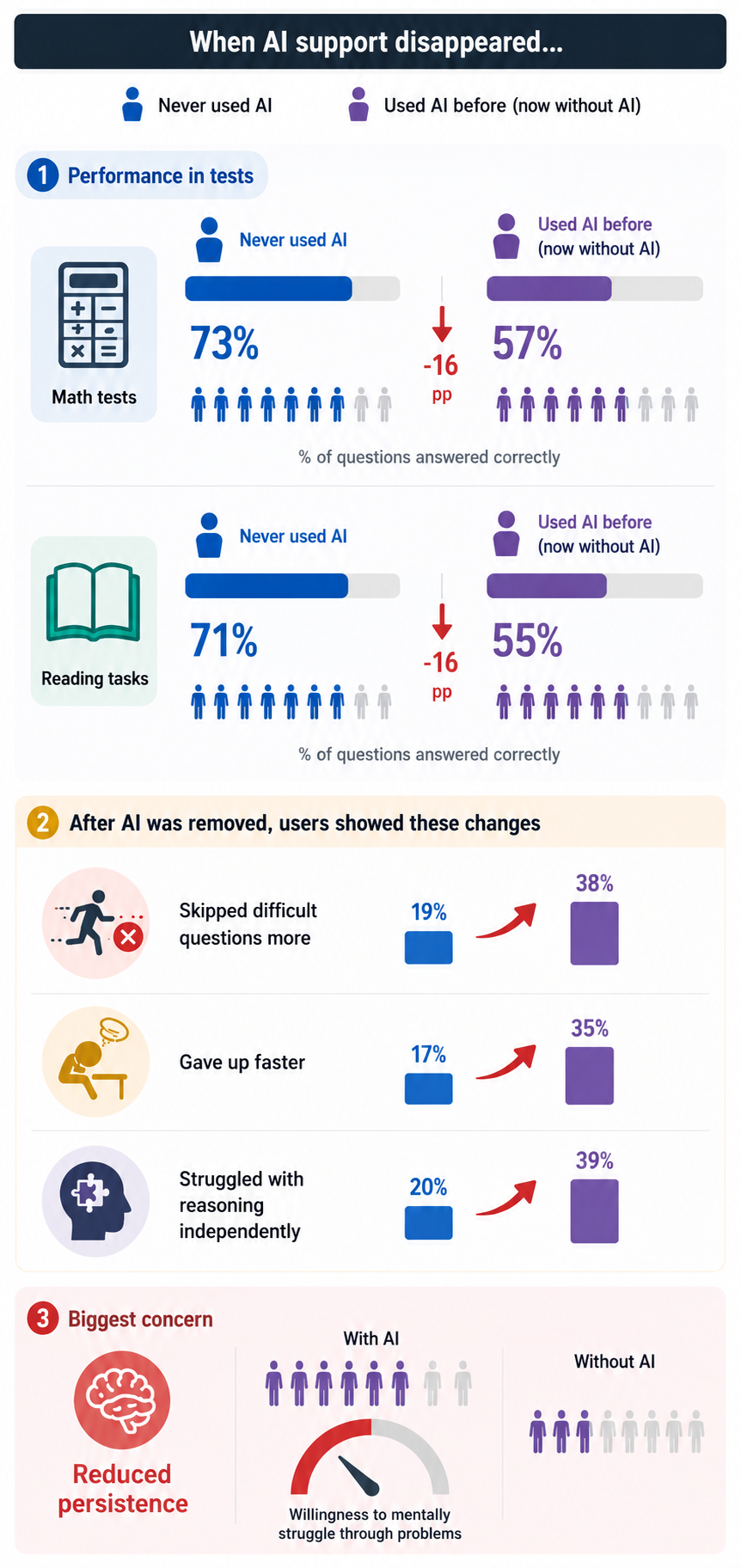
As soon as AI disappeared, there was a sudden drop in performance among users who relied on AI, the research suggested. In the maths-based tests, participants who had never used AI were able to solve the problems around 73 percent of the questions, while those who were dependent on AI earlier could solve only around 57 percent.
In the maths-based tests, participants who never used AI solved around 73% of the questions correctly. Meanwhile, those who depended on AI earlier managed only around 57% after the support vanished.
A similar trend appeared in reading-related tasks too. Once AI assistance was removed, users became more likely to skip difficult questions, give up faster or struggle with reasoning independently.
Interestingly, the researchers said the biggest concern was not just lower scores, but also reduced persistence. In simple words, participants became less willing to mentally struggle through problems once they got used to instant answers.
Is AI bad?
This is debatable, but not exactly. The study doesn't argue that AI tools are harmful by default. Instead, it highlights how people use them. Researchers found that participants who used AI mainly for hints, explanations, or guidance did not show the same level of decline. The bigger problem was with those users who relied on AI to directly complete tasks or give final answers.
That difference matters. Using AI as a "thinking partner" seems healthier than treating it like a replacement for thinking altogether.
A "boiling frog" effect?
The researchers describe this as a kind of "boiling frog" effect. One quick AI interaction may not seem harmful, but repeated dependence could slowly reduce a person's habit of deep thinking and problem-solving. At the same time, AI tools are becoming more common in schools, offices, and even healthcare. So, the main challenge is to learn how to use AI without switching off our own thinking process.
Get latest Tech and Auto news from Techlusive on our WhatsApp Channel, Facebook, X (Twitter), Instagram and YouTube.